



Homogeneous JSON template engine — the template is itself plain JSON.
transon turns one JSON document into another. You describe the shape of the
output as a template — itself plain JSON — and put small placeholder rules (objects
marked with "$") where data should flow in. No glue code to write, no separate
template language to learn.
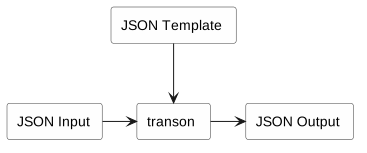
A template, some input, and what comes out — pull one field from every record:
Template:
{"$": "map", "item": {"$": "attr", "name": "email"}}Input:
[
  {"name": "Ada", "email": "ada@example.com"},
  {"name": "Alan", "email": "alan@example.com"},
  {"name": "Grace", "email": "grace@example.com"}
]
Output:
["ada@example.com", "alan@example.com", "grace@example.com"]Try it live in the documentation & playground.
- Templates are data. Store them in a database, generate them from code, review them as diffs, validate them before running — they are plain JSON values, not strings in a DSL.
- A few rules, endlessly combined. Iteration, lookups, conditionals, formatting — even arithmetic — are the same small building blocks, nested inside each other.
- Extend it in Python. Register your own rules, operators, and functions when the built-ins aren't enough.
Inspired by XSLT (declarative, tree-to-tree transformation) and JsonLogic (logic expressed as data).
pip install transonYour first transform:
from transon import Transformer

template = {"items": {"$": "map", "item": {"$": "item"}}}
Transformer(template).transform(["a", "b"]) # => {"items": ["a", "b"]}Things you'll appreciate once you start writing real templates:
- Missing data just disappears. An absent field produces "no value" rather than an
error; containers skip it instead of emitting
nullholes; and any lookup can declare adefault. - Catch template mistakes before running anything. Opt-in static validation checks a template's structure with no input data at all.
- Errors that point at the template. A malformed template and data that doesn't
fit are distinct errors, and both name the exact template path that failed
(
at template → …). - Emit anything — even data that looks like a rule. Literal
$keys are expressible, and the marker itself is configurable if$collides with your data. - The docs travel with the package. An installed
transonserves its own Language Reference, editor metadata, and generated docs — offline, version-matched.
JSON transformation is a crowded space. transon's bet is that templates are
themselves pure JSON — storable, generatable, diff-able, and extensible with your own
rules — traded against the terseness of a string DSL. Pick the tool that fits the job:
| Tool | Template / language | Extensible | Deps & runtime | Best when |
|---|---|---|---|---|
| transon | pure JSON tree | custom rules, operators, functions | none (Python stdlib) | templates must be stored / generated / validated as JSON, with domain-specific rules, in Python |
| JSONata | string expression DSL | limited | JS library | concise queries & expressions over JSON in JavaScript |
| jq | string filter language | limited | native binary | CLI piping and ad-hoc filtering in the shell |
| JSLT | string DSL (jq-like) | user functions | JVM | compact JSON→JSON on the JVM |
| Jolt | JSON spec | limited | JVM | declarative structural reshaping on the JVM |
| JsonLogic | JSON logic tree | limited | small libs (many languages) | portable business/boolean rules shared across services |
| JSON-e | JSON template | limited | JS / Python | parameterising JSON config with interpolation |
| Jsonnet | full templating language | yes | native binary | generating large config (e.g. Kubernetes) from a real language |
| json-templates | JSON with {{placeholders}} |
no | tiny JS library | simple value substitution into a JSON skeleton |
Where transon is not the best pick (worth being honest about):
- Expression-heavy transforms read far more concisely in a string DSL like JSONata
or jq —
transonspells(a + b) * cas a nested rule tree. - Maturity & ecosystem: jq and JSONata are battle-tested with large communities;
transonis young and Python-only.
The same transform — multiply each order's qty by its price — over input
{"orders": [{"qty": 2, "price": 3}, {"qty": 5, "price": 7}]}:
JSONata — a terse string expression:
orders.(qty * price)
transon — pure JSON, composable rules:
{
  "$": "chain",
  "funcs": [
    {"$": "attr", "name": "orders"},
    {
      "$": "map",
      "item": {
        "$": "expr",
        "op": "mul",
        "values": [
          {"$": "attr", "name": "qty"},
          {"$": "attr", "name": "price"}
        ]
      }
    }
  ]
}
Both yield [6, 35]. JSONata wins on brevity; transon wins when the template itself
must be data — stored in a database, generated by another program, reviewed as a
diff, checked with Transformer.validate(), or extended with your own rules.
transon was built with a set of key development principles in mind, including:
- Flexibility and Extensibility:
transonis designed to be highly flexible and extensible, allowing you to add new rules and types of placeholders to suit your unique needs. - Valid JSON Structure:
transontemplates are defined as valid JSON structures, making them easy to work with and compatible with a wide range of tools and applications. - Composable Rules:
transonrules are highly composable, allowing you to define complex behavior patterns using a combination of nested rules. For example, arithmetic expressions can be defined with nested rules, where each rule represents a specific operation. This approach eliminates the need for a domain-specific language (DSL) for arithmetic expressions. - Marker-Based Templates: The most important aspect of a
transontemplate is the use of the$marker. This marker is a special key within the JSON structure that distinguishes it from other types of JSON data. By default, the$key is used as the marker, but you can change it to any other value you prefer.
By using a marker-based approach, transon ensures that templates are easy to work with and can be easily distinguished from other types of JSON data.
This makes it simple to generate dynamic templates, manipulate JSON data, and produce new JSON structures that meet your specific requirements.
Additionally, the composable rules approach allows for advanced behavior patterns that can be defined using a combination of nested rules, making transon highly flexible and extensible.
Requires Python 3.9+ and uv.
uv sync --dev
uv run pytest .