Function secret sharing (FSS) primitives including:
- 2-party distributed point function (DPF), based on Boyle et al. (CCS '16) or Half-Tree (EUROCRYPT '23).
- 2-party distributed comparison function (DCF), based on Boyle et al. (EUROCRYPT '21) or Grotto (CCS '23).
- 2-party verifiable distributed point function (VDPF), based on Castro & Polychroniadou (EUROCRYPT '22).
Features:
- First-class support for GPU (based on CUDA)
- Top-tier performance shown by benchmarks
- Well-commented and documented
- Header-only library, easy for integration
Multi-party computation (MPC) is a subfield of cryptography that aims to enable a group of parties (e.g., servers) to jointly compute a function over their inputs while keeping the inputs private.
Secret sharing is a method that distributes a secret among a group of parties, such that no individual party holds any information about the secret.
For example, a number
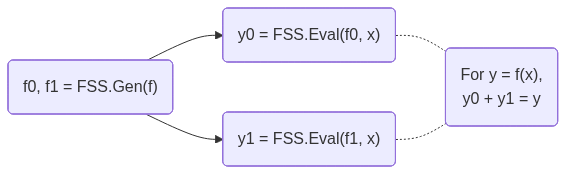
FSS is a scheme to secret-share a function into a group of function shares.
Each function share, called as a key, can be individually evaluated on a party.
The outputs of the keys are the shares of the original function output.
FSS consists of 2 methods: Gen for generating function shares as keys and Eval for evaluating a key to get an output share.
FSS's workflow is shown below:
DPF/DCF are FSS for point/comparison functions.
They are called out because 2-party DPF/DCF can have
- CMake >= 3.22
- CUDA toolkit >= 12.0 (for C++20 support). Tested on the latest CUDA toolkit.
- OpenSSL 3 (only required for CPU with AES-128 MMO PRG)
Clone the repository:
git clone https://github.com/myl7/fss.git
cd fss
Option A: Install via CMake and use find_package
cmake -B build -DBUILD_TESTING=OFF -DCMAKE_INSTALL_PREFIX=/path/to/install
cmake --build build
cmake --install build
Then in your project's CMakeLists.txt:
find_package(fss REQUIRED)
target_link_libraries(your_target fss::fss)
When configuring your project, point CMake to the install prefix:
cmake -B build -DCMAKE_PREFIX_PATH=/path/to/installOption B: Use as a subdirectory (header-only)
Without installing, you can define the target directly in your CMakeLists.txt, like the samples do:
add_library(fss INTERFACE)
target_include_directories(fss INTERFACE "/path/to/fss/include")
target_compile_features(fss INTERFACE cxx_std_20 cuda_std_20)
Then link it in your project:
target_link_libraries(your_target fss)This walks through using DPF and DCF on the CPU with AES-128 MMO PRG. This PRG requires OpenSSL.
-
Include the headers and set up type aliases:
#include <fss/dpf.cuh>
#include <fss/dcf.cuh>
#include <fss/group/bytes.cuh>
#include <fss/prg/aes128_mmo.cuh>

constexpr int kInBits = 8;  // Input domain: 2^8 = 256 values
using In = uint8_t;
using Group = fss::group::Bytes;

// DPF uses mul=2, DCF uses mul=4
using DpfPrg = fss::prg::Aes128Mmo<2>;
using DcfPrg = fss::prg::Aes128Mmo<4>;
using Dpf = fss::Dpf<kInBits, Group, DpfPrg, In>;
using Dcf = fss::Dcf<kInBits, Group, DcfPrg, In>;
-
Create the PRG with AES keys and instantiate DPF/DCF:
// DPF PRG needs 2 AES keys
unsigned char key0[16] = {1, 2, 3, 4, 5, 6, 7, 8, 9, 10, 11, 12, 13, 14, 15, 16};
unsigned char key1[16] = {16, 15, 14, 13, 12, 11, 10, 9, 8, 7, 6, 5, 4, 3, 2, 1};
const unsigned char *keys[2] = {key0, key1};
auto ctxs = DpfPrg::CreateCtxs(keys);

DpfPrg prg(ctxs);
Dpf dpf{prg};
-
Run
Gento generate correction words (keys) from secret inputs:In alpha = 42; // Secret point / threshold int4 beta = {7, 0, 0, 0}; // Secret payload (LSB of .w must be 0) // Random seeds for the two parties (LSB of .w must be 0) int4 seeds[2] = { {0x11111111, 0x22222222, 0x33333333, 0x44444440}, {0x55555555, 0x66666666, 0x77777777, static_cast<int>(0x88888880u)}, }; Dpf::Cw cws[kInBits + 1]; dpf.Gen(cws, seeds, alpha, beta);
-
Run
Evalon each party and reconstruct using the group:// Each party evaluates independently int4 y0 = dpf.Eval(false, seeds[0], cws, alpha); int4 y1 = dpf.Eval(true, seeds[1], cws, alpha); // Reconstruct via the group: convert to group elements, add, convert back // For Bytes group this is XOR; for Uint group this is arithmetic addition int4 sum = (Group::From(y0) + Group::From(y1)).Into(); // sum == beta at x == alpha, 0 otherwise
-
Free the AES contexts when done:
DpfPrg::FreeCtxs(ctxs);
DCF follows the same pattern — use DcfPrg (mul=4, needs 4 AES keys), Dcf, and Dcf::Cw. The reconstructed output equals beta when x < alpha and 0 otherwise.
Link with OpenSSL in your CMakeLists.txt:
find_package(OpenSSL REQUIRED)
target_link_libraries(your_target fss OpenSSL::Crypto)
See samples/dpf_dcf_cpu.cu for the complete working example.
This walks through using DPF and DCF on the GPU with ChaCha PRG.
-
Include the headers and set up type aliases:
#include <fss/dpf.cuh>
#include <fss/dcf.cuh>
#include <fss/group/bytes.cuh>
#include <fss/prg/chacha.cuh>

constexpr int kInBits = 8;
using In = uint8_t;
using Group = fss::group::Bytes;

// DPF uses mul=2, DCF uses mul=4
using DpfPrg = fss::prg::ChaCha<2>;
using DcfPrg = fss::prg::ChaCha<4>;
using Dpf = fss::Dpf<kInBits, Group, DpfPrg, In>;
using Dcf = fss::Dcf<kInBits, Group, DcfPrg, In>;
-
Set up a nonce in constant memory and create the PRG in a kernel:
__constant__ int kNonce[2] = {0x12345678, 0x9abcdef0};

__global__ void GenKernel(Dpf::Cw *cws, const int4 *seeds, const In *alphas, const int4 *betas) {
    int tid = blockIdx.x * blockDim.x + threadIdx.x;

    DpfPrg prg(kNonce);
    Dpf dpf{prg};

    int4 s[2] = {seeds[tid * 2], seeds[tid * 2 + 1]};
    dpf.Gen(cws + tid * (kInBits + 1), s, alphas[tid], betas[tid]);
}
-
Prepare host data, copy to device, and launch the
Genkernel:int4 *d_seeds = /* cudaMalloc + cudaMemcpy seeds to device */; In *d_alphas = /* cudaMalloc + cudaMemcpy alphas to device */; int4 *d_betas = /* cudaMalloc + cudaMemcpy betas to device */; Dpf::Cw *d_cws; cudaMalloc(&d_cws, sizeof(Dpf::Cw) * (kInBits + 1) * N); GenKernel<<<blocks, threads>>>(d_cws, d_seeds, d_alphas, d_betas);
-
Write and launch an
Evalkernel for each party, then copy results back:__global__ void EvalKernel(int4 *ys, bool party, const int4 *seeds, const Dpf::Cw *cws, const In *xs) { int tid = blockIdx.x * blockDim.x + threadIdx.x; DpfPrg prg(kNonce); Dpf dpf{prg}; ys[tid] = dpf.Eval(party, seeds[tid], cws + tid * (kInBits + 1), xs[tid]); } // Launch for party 0 and party 1, then copy d_ys back to host EvalKernel<<<blocks, threads>>>(d_ys, false, d_seeds0, d_cws, d_xs); EvalKernel<<<blocks, threads>>>(d_ys, true, d_seeds1, d_cws, d_xs);
-
Reconstruct on the host using the group, same as the CPU case:
int4 sum = (Group::From(h_y0s[i]) + Group::From(h_y1s[i])).Into();
DCF follows the same pattern — use DcfPrg (mul=4), Dcf, and Dcf::Cw.
See samples/dpf_dcf_gpu.cu for the complete working example.
You may see warnings like "integer constant is so large that it is unsigned" during compilation. These cannot be easily suppressed but are harmless and can be safely ignored.
Microbenchmarks for DPF/DCF Gen/Eval using Google Benchmark, covering both CPU (AES-128 MMO PRG) and GPU (ChaCha PRG) paths.
Configure with BUILD_BENCH=ON and build the targets:
cmake -B build -DBUILD_BENCH=ON -DCMAKE_BUILD_TYPE=RelWithDebInfo
cmake --build build --target bench_cpu bench_gpu
Run all benchmarks:
./build/bench_cpu
./build/bench_gpu
Run a subset using --benchmark_filter (regex):
./build/bench_cpu --benchmark_filter=BM_DcfGen
./build/bench_cpu --benchmark_filter=BM_DpfEval_Uint/20Run on Intel Xeon Platinum 8352V @ 2.10GHz (Ice Lake), single core, performance governor, pinned with taskset -c 0.
-------------------------------------------------------------------------------
Benchmark                                     Time             CPU   Iterations
-------------------------------------------------------------------------------
BM_DpfEval_Uint_Aes/20                     1704 ns         1703 ns       423203
BM_DpfEval_Uint_Aes/14                     1117 ns         1117 ns       623553
BM_DpfEval_Uint_Aes/17                     1408 ns         1407 ns       501122
BM_DpfGen_Uint_Aes/20                      3226 ns         3224 ns       215461
BM_DpfEval_Bytes_Aes/20                    1609 ns         1609 ns       431192
BM_DpfEvalAll_Uint_Aes/20             166795841 ns    166741828 ns            5 items_per_second=6.28862M/s
BM_DpfEval_Uint_ChaCha/20                 44940 ns        44911 ns        16889
BM_DpfEval_Uint_AesSoft/20                16184 ns        16172 ns        42681
BM_DcfEval_Uint_Aes/20                     4318 ns         4315 ns       193683
BM_DcfGen_Uint_Aes/20                      7461 ns         7456 ns        94162
BM_DcfEval_Bytes_Aes/20                    3685 ns         3683 ns       187611
BM_DcfEvalAll_Uint_Aes/20             267235391 ns    267066584 ns            3 items_per_second=3.92627M/s
BM_DcfEvalAll_Bytes_Aes/20            276631759 ns    276403133 ns            2 items_per_second=3.79365M/s
BM_VdpfEval_Uint_Aes_Sha256/20             2959 ns         2957 ns       238919
BM_VdpfGen_Uint_Aes_Sha256/20              6000 ns         5998 ns       100000
BM_VdpfEval_Uint_Aes_Blake3/20             7354 ns         7349 ns        95737
BM_VdpfProve_Uint_ChaCha_Blake3/20         1890 ns         1888 ns       363291
BM_VdpfEvalAll_Uint_Aes_Sha256/20    1424750352 ns   1424019165 ns            1 items_per_second=736.35k/s
BM_HalfTreeDpfEval_Uint_Aes/20              985 ns          985 ns       722157
BM_HalfTreeDpfGen_Uint_Aes/20              2204 ns         2203 ns       319493
BM_HalfTreeDpfEvalAll_Uint_Aes/20      97681794 ns     97599273 ns            7 items_per_second=10.7437M/s
BM_GrottoDcfEval_Aes/20                    46.9 ns         46.9 ns     15044877
BM_GrottoDcfPreprocess_Aes/20         130893070 ns    130785021 ns            5
BM_GrottoDcfPreprocessEvalAll_Aes/20  260231883 ns    260023892 ns            3 items_per_second=4.03261M/s
Run on NVIDIA RTX A6000 (48GB VRAM), CUDA 12.6, driver 560.35.05. Each iteration runs 1M (2^20) Gen/Eval in parallel. The GPU was warmed up before running the benchmarks.
-------------------------------------------------------------------------------------------------
Benchmark                                       Time             CPU   Iterations UserCounters...
-------------------------------------------------------------------------------------------------
BM_DpfEval_Uint/20/manual_time            5003011 ns      7320763 ns          100 items_per_second=209.589M/s
BM_DpfEval_Uint/14/manual_time            1283038 ns      3108089 ns          527 items_per_second=817.26M/s
BM_DpfEval_Uint/17/manual_time            1664344 ns      3599944 ns          425 items_per_second=630.024M/s
BM_DpfGen_Uint/20/manual_time             5530518 ns      7397631 ns          113 items_per_second=189.598M/s
BM_DpfEval_Bytes/20/manual_time           4356800 ns      6046874 ns          139 items_per_second=240.676M/s
BM_DpfEval_Uint_AesSoft/20/manual_time   20864855 ns     22624837 ns           29 items_per_second=50.2556M/s
BM_DcfEval_Uint/20/manual_time            4356972 ns      6142652 ns          173 items_per_second=240.666M/s
BM_DcfGen_Uint/20/manual_time             5926477 ns      8139248 ns          114 items_per_second=176.931M/s
BM_VdpfEval_Uint/20/manual_time           3990959 ns      5761747 ns          155 items_per_second=262.738M/s
BM_VdpfGen_Uint/20/manual_time            5787254 ns      7720680 ns          130 items_per_second=181.187M/s
BM_HalfTreeDpfEval_Uint/20/manual_time    1746974 ns      4011309 ns          403 items_per_second=600.224M/s
BM_HalfTreeDpfGen_Uint/20/manual_time     5996544 ns      8311199 ns          118 items_per_second=174.863M/s
GPU kernel register usage (compiled for sm_52, --ptxas-options=-v):
| Kernel | Group | Registers | Stack | Smem |
|---|---|---|---|---|
| DpfEval | Uint/Bytes | 39 | ||
| DpfGen | Uint/Bytes | 48 | ||
| DpfEvalAes | Uint | 72 | 992B | 1280B |
| DpfGenAes | Uint | 72 | 992B | 1280B |
| HalfTreeDpfEval | Uint | 41 | ||
| HalfTreeDpfGen | Uint | 47 | ||
| VdpfEval | Uint | 38 | ||
| VdpfGen | Uint | 72 | ||
| DcfEval | Uint | 38 | ||
| DcfGen | Uint | 56 |
The AES-based kernels use shared memory and spill to stack. All other kernels have zero spills.
Generate a CPU flamegraph with perf and FlameGraph:
perf record -g ./build/bench_cpu --benchmark_filter=BM_DpfEval_Uint/20
perf script | /path/to/FlameGraph/stackcollapse-perf.pl | /path/to/FlameGraph/flamegraph.pl > build/flamegraph.svg
Open build/flamegraph.svg in a browser. The graph is interactive: click a frame to zoom in.
Apache License, Version 2.0
Copyright (C) 2026 Yulong Ming [email protected]