
Strip the AI packaging. Keep the meaning.





Try it in the browser — no install
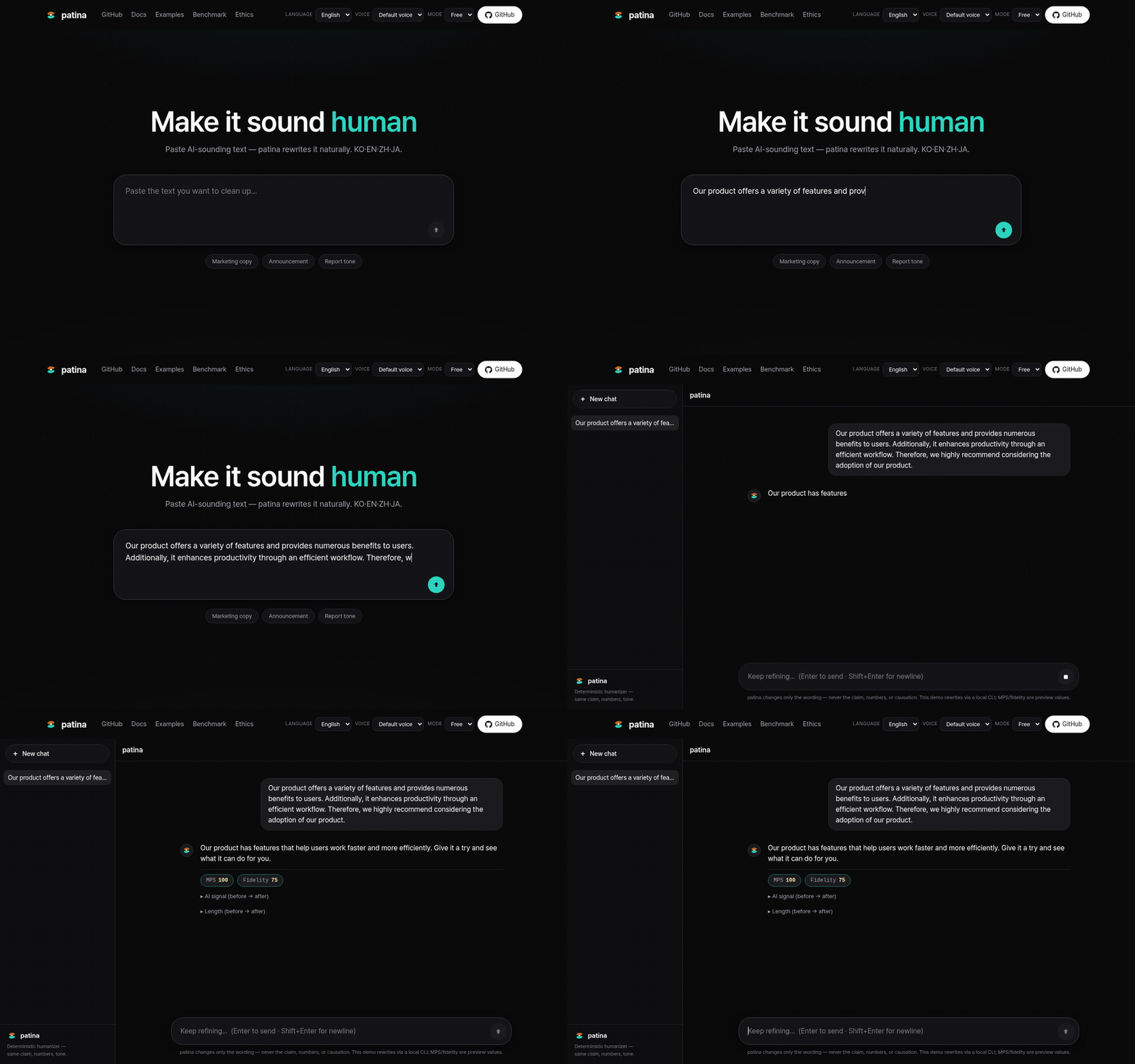
Paste AI-sounding text → patina rewrites it in place, keeps the facts (the "30 templates" number survives), and drops the deterministic AI signal 100 → 0 (MPS 100 / Fidelity 75).
The words are not the tell. The architecture is. We ran a pre-registered study with independent cross-family LLM judges: a rewrite can strip the AI vocabulary, yet judges still recognize AI documents by their shape — uniform paragraphs, checklist-complete coverage, the tidy problem→lesson arc. Word-level cleanup moved judged AI-likeness a lot on English documents (−23 points) and barely at all on long Korean ones. That result decides patina's design: detect both layers, and publish the losses next to the wins (the study).
patina is a deterministic, pattern-based humanizer for Korean, English, Chinese, and Japanese. It finds AI-sounding phrasing and rewrites it without changing the claim, numbers, polarity, or causation. It is not a black-box paraphraser, authorship detector, or detector-bypass tool — it is built for allowed AI-assisted drafting where the author wants cleaner voice, an audit trail, and meaning-preservation checks.
More examples: Before/After Gallery (한국어) · CLI transcript.
Open patina.vibetip.help — paste KO / EN / ZH / JA text for a real rewrite gated by the MPS/fidelity floors, with the deterministic AI signal measured before → after. Rewrites and scoring run server-side; the free tier uses the service's own model key (rate-limited). API mode forwards your own key per request through the patina server to the provider you pick — never stored or logged (metrics are sanitized: no text, prompt, output, key, or IP). A hosted Pro tier unlocks higher limits — see pricing.
Let your coding agent install it — paste this into Claude Code, Codex CLI, Cursor, Gemini CLI, or any agent:
Install patina by following https://raw.githubusercontent.com/devswha/patina/main/INSTALLATION.md
The agent fetches INSTALLATION.md (written for AI agents) and runs the right install path for your host, then verifies it. Or do it yourself:
Claude Code — plugin marketplace (no clone, recommended):
/plugin marketplace add devswha/patina
/plugin install patina@patina
Claude Code · Codex CLI · Cursor · OpenCode — install script:
curl -fsSL https://raw.githubusercontent.com/devswha/patina/main/install.sh | bashThen run the skill from Claude Code, Codex CLI, Cursor, or OpenCode:
/patina --lang en

[paste your text here]
Useful skill calls:
/patina --document-type email --register professional
/patina --document-type blog --persona pragmatic-founder
Requires Node.js >= 18.
npx patina-cli doctor
npx patina-cli --lang en input.txt
Use a logged-in local model CLI without an API key:
printf '%s\n' 'Coffee has emerged as a pivotal cultural phenomenon.' \
  | npx patina-cli --lang en --backend codex-cli
Supported local backends: codex-cli, claude-cli, gemini-cli, kimi-cli — patina passes the strongest documented default model per backend. See Authentication (한국어).
For large --batch runs, prefer an OpenAI-compatible HTTP backend; local CLI backends are agent runtimes, capped conservatively with --timeout-ms, --max-concurrency, --max-retries, and --max-failures for batch safety.
| 184 patterns | 37 rewrite-capable + 9 score-only viral-hook per language (46 each across KO/EN/ZH/JA) — see the full 184-pattern catalog in PATTERNS.md |
| Modes | rewrite · verify · audit · score · diff |
| Surfaces | agent skill · Node CLI · in-place preview · browser playground (rewrite + score) |
| Rewrite axes | --document-type controls genre/policy · --persona controls reusable voice · --register controls casual/professional delivery |
| Free usage | logged-in codex, claude, or gemini CLI can run rewrites without PATINA_API_KEY |
| Calibration | 67.3% editing-hotspot catch [63.5–71.0%] across GPT-5.5 / Claude Sonnet 4.6 / Gemini 2.5 Pro (n=600, KO+EN); 16.0% false positives [11.6–21.7%] on KO+EN human controls (n=200) |
| License | MIT |
Scores are editing signals with false positives and false negatives, not proof of authorship. See Ethics.
Patina does not infer one axis from another. Omit Persona and Register to keep the source voice and register.
| Axis | Controls | Does not control | CLI | Config | Playground |
|---|---|---|---|---|---|
| Document Type | Genre, purpose, structural conventions, pattern policy | Voice, casual/professional delivery, meaning floors | --document-type |
document-type |
Document |
| Persona | Reusable voice fingerprint: vocabulary, rhythm, explanation habits | Genre, pattern policy, register, meaning floors | --persona |
persona |
Voice |
| Register | casual or professional delivery |
Genre, persona identity, pattern policy | --register |
register |
Register |
| Meaning preservation is the outer guard. If instructions appear to overlap, | |||||
| field ownership resolves them: Document Type wins for document structure and | |||||
| domain constraints, Persona for idiolect and rhythm, and Register for | |||||
| casual/professional markers. An explicit value never fills an omitted axis. |
Examples:
patina --document-type email --register professional note.md
patina --document-type blog --persona pragmatic-founder post.md
patina --document-type technical --persona technical-explainer --register casual guide.mdpatina --lang <ko|en|zh|ja> [mode] [--document-type <name>] [--persona <name>] [--register <name>] input.txt| Command | Purpose |
|---|---|
patina input.txt |
rewrite with defaults |
patina --audit input.txt |
detect patterns only |
patina --score input.txt |
output a 0-100 score using the LLM judge plus deterministic signals |
patina --score --offline input.txt |
score with deterministic signals only; no backend or API key |
patina --score --offline --exit-on 30 input.txt |
offline CI gate with exit code 3 when overall > 30 |
patina --diff input.txt |
show pattern-by-pattern changes |
patina --preview page.html |
render rewrites back onto a saved HTML page with toggles and inline diff |
patina --verify input.txt |
rewrite, then check MPS/fidelity floors with one retry |
patina --document-type email --register professional input.txt |
use email conventions with professional delivery |
patina --persona pragmatic-founder input.txt |
rewrite in a built-in voice persona |
patina persona new my-voice --from-sample past.txt |
author your own persona from a writing sample |
patina persona list |
list built-in + custom personas |
patina persona show my-voice --json |
print a persona's normalized config (never the docs body) |
patina persona edit my-voice --name "New Name" |
copy-on-edit a persona into custom/personas/ |
patina persona rm my-voice |
remove a custom persona (built-ins are protected) |
patina --format json --quiet input.txt |
script-friendly output |
patina --batch docs/*.md --outdir cleaned/ |
batch file processing |
patina --help prints the full flag list. patina doctor --json checks Node, backend, tmux, and API-key readiness without making an LLM call.
A persona is a reusable voice — a built-in (patina persona list) or your own, authored without editing source:
patina persona new my-voice --from-sample past-posts.txt   # learn from your writing
patina persona new my-voice --describe "plain-spoken founder, casual"
patina --persona my-voice draft.md                          # then reuse it

patina persona show my-voice                                # inspect the normalized config (--json for machine output)
patina persona edit my-voice --name "Founder voice"         # copy-on-edit into custom/personas/ (built-ins stay intact)
patina persona rm my-voice                                  # remove a custom persona (--force to skip the confirm)
Works on ko/en/zh/ja and composes independently with --document-type and --register. Persona v2 changes reusable voice only; it cannot select a document type, set register, change pattern policy, or define verification/meaning floors. Authored Personas are validated on save, while global rewrite guards and --verify enforce meaning preservation independently.
For GitHub Actions, the maintained wrapper is shorter than hand-rolled setup:
name: Patina prose score
on:
  pull_request:
    paths: ['**/*.md', '**/*.mdx']
permissions:
  contents: read
  pull-requests: read
  issues: write
jobs:
  patina:
    runs-on: ubuntu-latest
    steps:
      - uses: actions/checkout@v6
      - uses: devswha/patina-action@v1
        with:
          score-threshold: 30
          lang: auto
          comment: true
Other integrations: pre-commit, static sites, Docker, release workflow.
Input
  -> semantic anchor extraction (claims, polarity, causation, numbers)
  -> stylometry + AI-lexicon scan
  -> pattern-guided rewrite
  -> self-audit and MPS/fidelity checks
  -> cleaned text
If meaning drifts, the change is retried or rolled back. Deterministic analysis lives in src/features/*; LLM-backed rewrite and score calls use the selected backend.
# .patina.yaml
version: "7.0.0"
language: ko              # ko | en | zh | ja
document-type: default    # genre/purpose + pattern policy
persona:                  # optional reusable voice; omit to preserve source
register:                 # casual | professional; omit to preserve source
Project .patina.yaml overrides defaults. Pattern packs are auto-discovered by language prefix. Additive list keys (blocklist, allowlist, skip-patterns) merge; other arrays replace.
Start here:
- Cookbook — common recipes and workflows
- CLI Contract — flags, formats, score gates, exit behavior
- Authentication — local CLI backends and API providers
- Patterns — full pattern catalog
- Subagents & strict flow — optional read-only detector/fidelity/naturalness subagents and the
--strictmulti-pass mode - Benchmarks · latest report · 2026 rebaseline
- Measurement harness — index of every benchmark, calibration, and gate tool (incl. the signal-impact ablation harness)
- FAQ (한국어)
- Ethics
- Contributing (한국어)
- Changelog
Brand assets and usage rules live in Branding. Design notes live in DESIGN.md.
Inspired by oh-my-zsh's plugin architecture, Wikipedia's "Signs of AI writing", and blader/humanizer.