🏆 1st Place - DragonHack 2026 - Epilog Clean Code challenge 🏆
✨ A novel pipeline that nobody has shipped. ✨




Creating simulatable digital twins of real environments is either 💸 expensive (NVIDIA Omniverse + enterprise RTX), 🛠️ manual (Blender + hand-authored URDFs), or 🧩 incomplete (Gaussian-splat pipelines produce no watertight mesh for conventional physics).
🚫 No shipped product does all three: run on an affordable edge camera, produce mesh-based simulator-portable output, and deliver an interactive result in a browser with zero backend compute.
✅ VID2SIM does. Point an OAK-4 D Pro at a room for 15 seconds, and under a minute later a judge is dropping balls on your chairs in a browser tab.
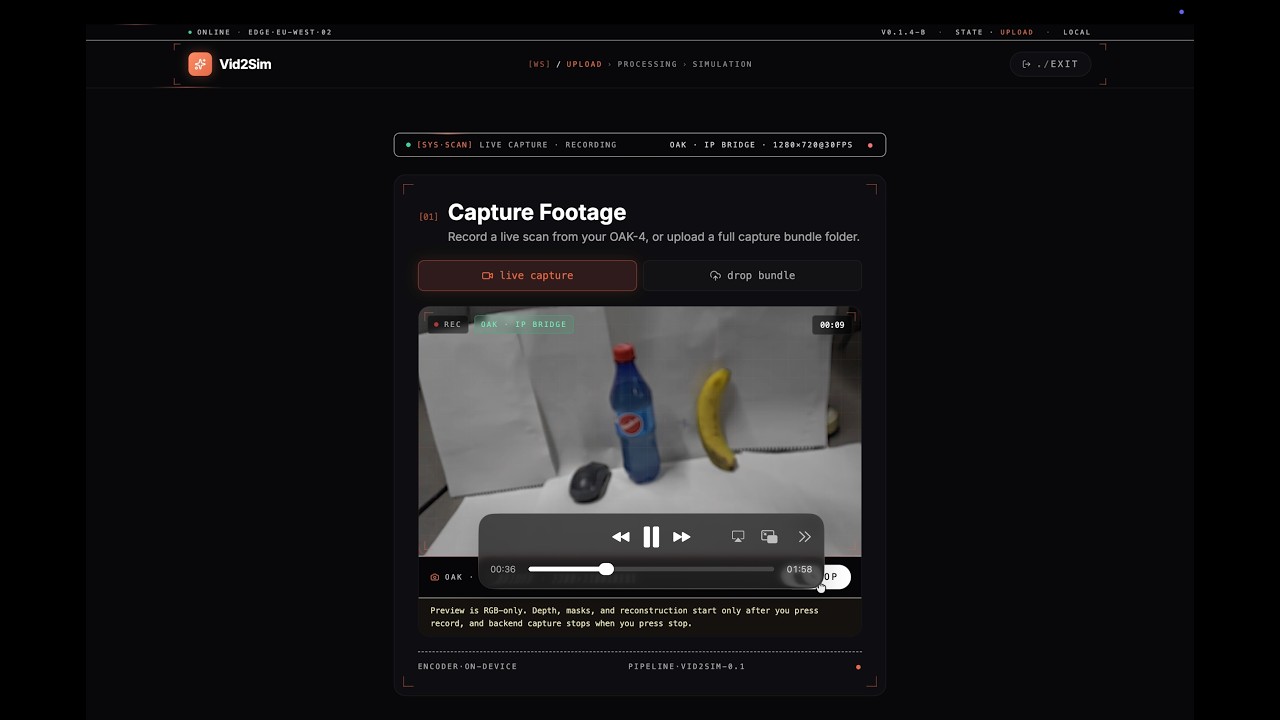
Click on the image above to watch the full demo! Funny thing - YOLO picked up the objects once again as a dining table lol
   ┌──────── 📷 OAK-4 D Pro (edge NPU) ─────┐
   │  LENS stereo depth + IMU                │
   │  YOLOv8 hero-object segmentation        │
   │  ObjectTracker 3D + SpatialLocationCalc │
   └──────────────────┬──────────────────────┘
                      │ USB-C
                      ▼
   ┌──────── 💻 M3 Max (offline, local) ────┐
   │  A. Geometry recovery (depth + VIO)     │
   │  B. SF3D mesh completion + textures     │
   │  C. Physics inference (VLM → props)     │
   │  D. scene.json + glTF / MJCF exporters  │
   └──────────────────┬──────────────────────┘
                      │
                      ▼
   ┌──────── 🌐 Browser (Three.js) ─────────┐
   │  Rapier WASM · 60 FPS · no backend      │
   │  Click, drop, throw, knock over         │
   └─────────────────────────────────────────┘
| Stage | What happens | Tech |
|---|---|---|
| 👁️ A — Perception | On-device depth + segmentation on the OAK NPU | LENS stereo, YOLOv8, ObjectTracker 3D |
| 🧊 B — Completion | Feed-forward image-to-3D fills the unseen back of each object | SF3D (watertight + baked textures) |
| ⚖️ C — Physics | VLM infers {mass, friction, restitution, material} per object |
Claude Opus 4.7 + PhysQuantAgent visual prompting |
| 🎮 D — Delivery | Typed scene.json → glTF + MJCF → browser viewer |
Three.js + Rapier WASM |
- 👀 The camera only sees the front of every object. A physics engine needs a closed mesh. SF3D hallucinates the back; the depth camera anchors scale and pose via ICP. Neither alone is enough — their composition is the engineering contribution.
- 📏 Depth has to be metric. Stereo is noisy on thin / low-texture surfaces; monocular foundation models are smooth but scale-free. We fuse both.
- 🧪 Physics has to be plausible. Mass and friction aren't in the pixels. A VLM with visual-prompting reads material cues off the crop and emits structured JSON.
- 🛰️ The demo has to survive a flaky venue network. Zero-backend browser runtime. Nothing phones home once the scene is built.
VID2SIM is a four-stage ML pipeline, but under the hood it's four bounded contexts talking through a single typed contract. No stage knows how any other stage is implemented.
┌─────────────────┐  ┌─────────────────┐  ┌─────────────────┐  ┌─────────────────┐
│  👁️ Perception  │→ │ 🧊 Reconstruction│→ │ 🏗️ Scene Assembly│→ │ 🎮 Presentation │
│                 │  │                 │  │                 │  │                 │
│ OAK capture,    │  │ SF3D mesh       │  │ VLM physics,    │  │ Three.js +      │
│ depth fusion,   │  │ completion,     │  │ convex decomp,  │  │ Rapier WASM,    │
│ segmentation    │  │ ICP alignment   │  │ exporters       │  │ interactive UX  │
└────────┬────────┘  └────────┬────────┘  └────────┬────────┘  └────────┬────────┘
         │                    │                    │                    │
         └────────────────────┴────────────────────┴────────────────────┘
                                       │
                            🔗 scene.json (ubiquitous language)
- 🧩 Separation of concerns. Each context owns its models, its dependencies, and its tests. Swapping Hunyuan3D for SF3D touched one context; the other three never noticed.
- 🗣️ Ubiquitous language. The
scene.jsonschema is the only cross-context contract — typed, JSON-Schema-validated, versioned, tested. - 🧵 Independent deliverability. Four people worked in parallel across four contexts through the whole 24 h without stepping on each other.
- 🔌 Pluggable anti-corruption layers. Exporters (glTF / MJCF / USD) are adapters off the scene context — not leaks into it.
Context boundaries are documented in docs/plans/ (one plan per context) and the decisions behind them live in the ADRs.
🧊 SF3D — Stable Fast 3D (Stability AI)
We used SF3D, a feed-forward network for mesh generation, to fill out the unseen parts of the hero objects. We tried Hunyuan3D 2.1 and TripoSG 1.5B as alternatives. SF3D won on three axes:
- ⚡ Speed — feed-forward single pass, meaningfully quicker per object than the diffusion-based alternatives.
- 🎨 Integrated texture — SF3D bakes PBR textures in the same forward pass. Hunyuan3D needs a separate Paint 2.1 stage; TripoSG outputs untextured geometry.
- 💎 Mesh quality — near-parity with Hunyuan3D on our indoor-object test set. The quality gap did not justify the wall-time + pipeline-complexity cost.
🏆 SF3D is what made the 60-second budget achievable.
.
├── 🐍 src/               # Python pipeline (capture → scene.json)
├── ⚛️  FrontendVid2Sim/   # React + Three.js + Rapier browser viewer
├── 📋 spec/              # scene.json JSON Schema + fixtures
├── 🛠️  scripts/           # OAK UVC bridge, capture helpers
├── 📚 docs/
│   ├── VID2SIM_PRD.md        # Full product requirements
│   ├── adr/                  # 9 architecture decision records
│   └── plans/                # Per-bounded-context implementation plans
├── 🧪 tests/             # pytest (fusion math + exporters)
└── 🎞️  data/captures/     # Recorded OAK sessions
# One-time
python -m venv .venv && source .venv/bin/activate
pip install -e .

# Run the pipeline on a capture
python -m src.vid2sim.cli --capture data/captures/<session_id>cd FrontendVid2Sim
npm install
npm run dev🔌 The Vite plugin auto-starts the OAK UVC bridge for live capture.
| Sponsor | Category | What we shipped |
|---|---|---|
| 📷 Luxonis | Best Vision Hack | On-device LENS + YOLOv8 + ObjectTracker on the OAK-4 NPU |
| 🎖️ Guardiaris | Most Innovative | Capture-to-trainer pipeline with MJCF export |
| 🏢 Preskok | B2B | Plug-and-play, no CAD, no consultant |
| 🎲 Zero Days | Fun & Scalable | Click in a browser, watch physics |
| 🧹 Epilog | Code Quality | DDD bounded contexts, typed scene.json, exporter tests, ADRs |
| 🔗 Celtra | Best API Use | VLM + depth foundation model + multi-stage ML pipeline |
- 📘 Product Requirements Document
- 🏛️ Architecture Decision Records — 9 accepted ADRs
- 🗺️ Phased Plan
- 📋 Scene specification
🐉 Built in 24 hours at DragonHack 2026 (with a slight nightclub pause 🍻🪩🕺🏼) · Ljubljana 🇸🇮