Rust implementations of the JSON and JSON-schema operations used by
synalinks, exposed to Python as a
PyO3 extension module (synaops).
The goal is a drop-in, faster replacement for the equivalent pure-Python
helpers. Input/output types are plain Python dict / list / scalars — the
boundary is handled via pythonize, so
callers do not need to know there is Rust underneath.
Parity with the Python reference is asserted on every op and payload size
(see bench/test_parity.py). Headline speedups on realistic payloads:
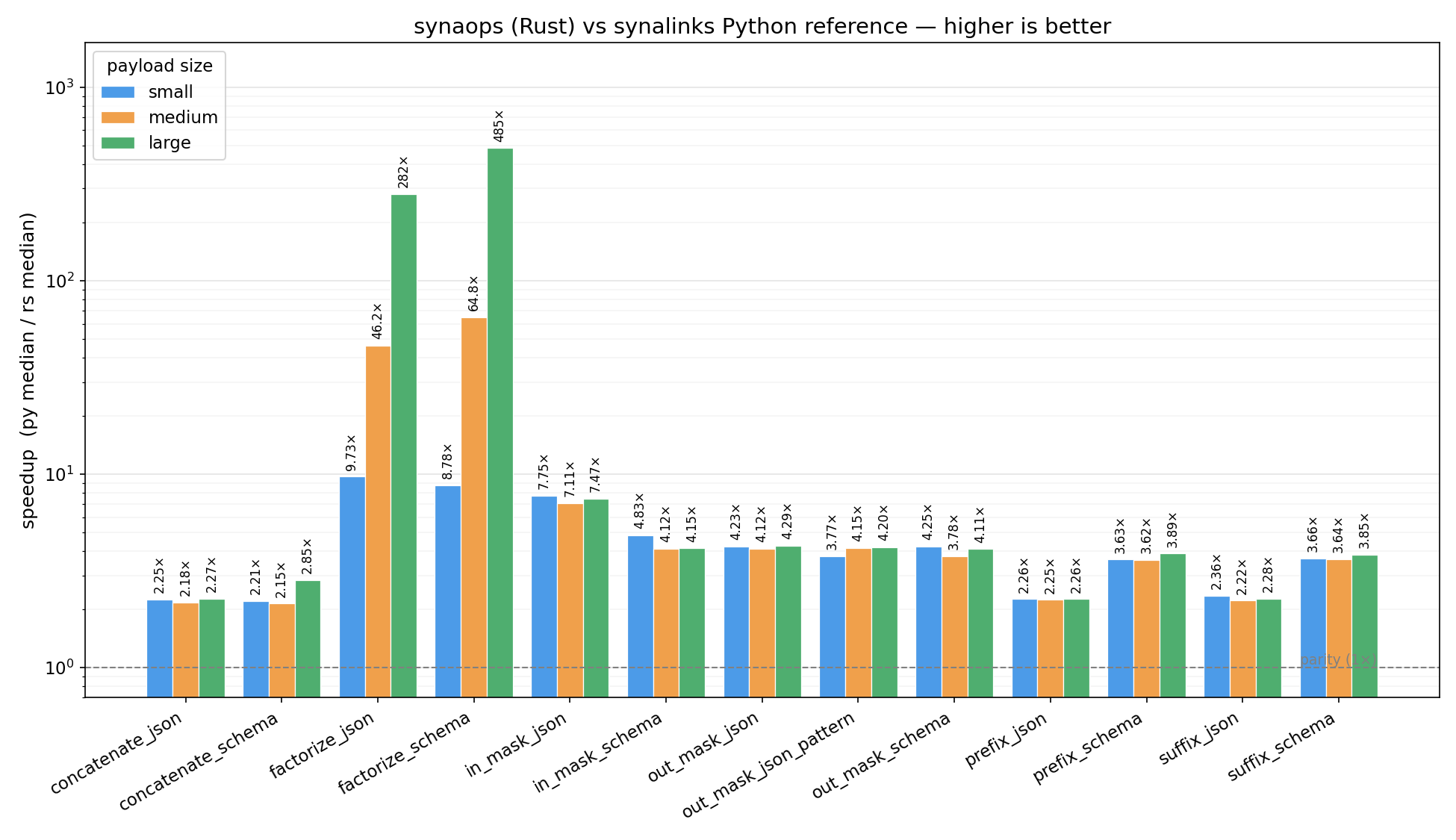
~470× on factorize_schema, ~290× on factorize_json at 600 keys,
4–8× on masking ops, 2–4× on simple key rewrites. Full table below.
pip install maturin
maturin develop --release # builds and installs into the active venvimport synaops| Function | Signature | Description |
|---|---|---|
prefix_json |
(json, prefix) |
Prepend prefix_ to every top-level key. |
suffix_json |
(json, suffix) |
Append _suffix to every top-level key. |
concatenate_json |
(json1, json2) |
Merge two objects; on key collision append _1, _2, … to disambiguate. |
factorize_json |
(json) |
Group keys sharing a singular base into a single array under the plural key. Inverse of decompose_json. |
decompose_json |
(json) |
Expand plural-keyed array properties into individual singular-keyed properties with numerical suffixes. Inverse of factorize_json. |
out_mask_json |
(json, mask=None, pattern=None, recursive=True) |
Drop keys whose base name is in mask or whose base name matches the regex pattern. Numerical suffixes are ignored when matching. |
in_mask_json |
(json, mask=None, pattern=None, recursive=True) |
Keep only the keys whose base name is in mask or matches pattern. In recursive mode, arrays are preserved and their object items are filtered in place. |
Operate on JSON-Schema-shaped dicts (properties, required, $defs, type, …).
| Function | Signature | Description |
|---|---|---|
prefix_schema |
(schema, prefix) |
Prepend prefix_ to every property key and update title / required accordingly. |
suffix_schema |
(schema, suffix) |
Append _suffix to every property key and update title / required accordingly. |
concatenate_schema |
(schema1, schema2) |
Merge two schemas (properties, required, $defs); on key collision append numeric suffixes and regenerate titles. |
factorize_schema |
(schema) |
Group similar singular-keyed properties into array-typed plural-keyed properties; folds heterogeneous items into anyOf. |
decompose_schema |
(schema) |
Expand plural-keyed array properties into a single singular-keyed property carrying the items schema. |
out_mask_schema |
(schema, mask=None, pattern=None, recursive=True) |
Remove properties whose base name is in mask or matches pattern. With recursive=True, descends into nested object/array properties and $defs, then prunes $defs entries no longer referenced. |
in_mask_schema |
(schema, mask=None, pattern=None, recursive=True) |
Keep only properties whose base name is in mask or matches pattern. Same recursive/$defs-pruning behavior as out_mask_schema. |
standardize_schema |
(schema) |
Placeholder for schema normalization (currently identity). |
is_object,is_array,is_schema_equal,contains_schemaare intentionally not ported. They are single-key lookups or dict comparisons whose cost is dominated by the PyO3 / dict-conversion boundary, so the pure-Python versions in synalinks are faster.
Both *_mask_* families and factorize_* / decompose_* rely on the NLP
helpers in nlp_utils.rs: they strip trailing numerical suffixes
(answer_3 → answer) and normalize singular/plural forms
(answers ↔ answer) before comparing keys. The pattern argument is a
regular expression matched via substring search against the base key (same
semantics as Python's re.search).
Measured on realistic payloads: nested objects, arrays of $ref-based
objects, schema $defs. Three payload sizes (12, 96, 600 top-level keys).
Parity with the Python reference is verified before each timing run
(pytest bench/test_parity.py, 45/45 pass).
Ratio py_median / rs_median per op. Higher is better; dashed line is parity (1×).
| Operation | small (12) | medium (96) | large (600) |
|---|---|---|---|
factorize_schema |
9.43× | 68.0× | 472× |
factorize_json |
10.3× | 48.9× | 291× |
in_mask_json |
8.11× | 7.37× | 7.75× |
out_mask_json_pattern |
4.16× | 4.27× | 4.49× |
out_mask_json |
4.37× | 4.17× | 4.42× |
in_mask_schema |
5.14× | 4.21× | 4.31× |
out_mask_schema |
4.67× | 3.92× | 4.16× |
prefix_schema |
3.91× | 3.79× | 4.16× |
suffix_schema |
3.90× | 3.80× | 4.10× |
decompose_schema |
2.65× | 2.44× | 3.33× |
concatenate_schema |
2.25× | 2.08× | 2.89× |
decompose_json |
2.74× | 2.48× | 2.56× |
prefix_json |
2.41× | 2.41× | 2.46× |
suffix_json |
2.63× | 2.40× | 2.42× |
concatenate_json |
2.44× | 2.46× | 2.30× |
factorize_* scales super-linearly because the Python reference does
repeated O(n) key scans per group; the Rust path groups in a single pass.
Simple key rewrites (prefix_*, suffix_*, concatenate_*) are bounded
by the PyO3 dict-conversion boundary, which is why they cluster around 2–4×.
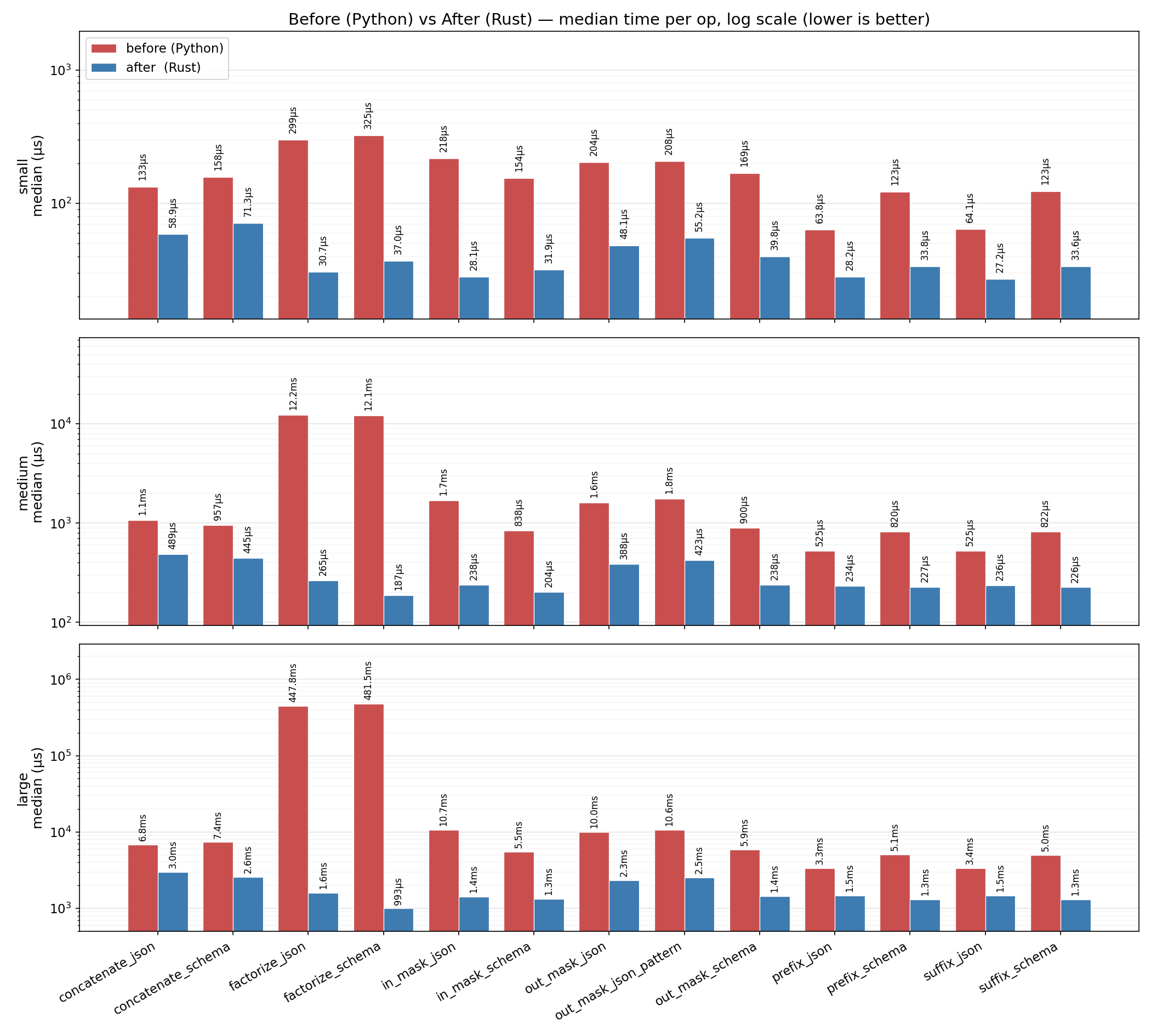
Log scale, lower is better. Rows are the three payload sizes.
See bench/README.md for the harness, payload shapes, and how to
regenerate these charts.
cargo test              # run Rust unit tests
maturin develop         # install debug build into venv
maturin develop --release

# Parity + performance against the Python reference impl
pytest bench/test_parity.py -v
pytest bench/test_bench.py --benchmark-save=latest
python bench/plot.py # writes bench/speedup.pngApache-2.0