




Midaz is a composable core banking platform built around a double-entry ledger. One Go monorepo ships the ledger core (onboarding, transactions, CRM, fees), real-time transaction validation and fraud prevention (Tracer) — all under the Elastic License 2.0, source-available. Transactional messaging (PIX, cards, wires) and governance integrations remain external and plug in via the marketplace.
- Ledger core (one binary): double-entry accounting over the full financial hierarchy — onboarding (organizations, ledgers, assets, portfolios, segments, accounts), n:n transactions, CRM (holders and instruments) with field-level encryption and searchable hashing so PII stays queryable without exposing plaintext, and in-process fee calculation on the transaction path.
- Tracer: real-time transaction validation and fraud prevention — a CEL rule engine, multi-scope spending limits, and a hash-chained immutable audit trail for compliance.
Prerequisites: Go 1.26.4+ and Docker.
git clone https://github.com/LerianStudio/midaz.git
cd midaz
make set-env   # create .env files from .env.example
make up        # start infra, then all services
Services after make up:
| Service | URL |
|---|---|
| Ledger API | http://localhost:3002 |
| Tracer | http://localhost:4020 |
Full guide, API references, and best practices: docs.lerian.studio.
Both Go units build from the single root module (github.com/LerianStudio/midaz/v4) and ship under a single unified version.
| Unit | Port | Role | Stores |
|---|---|---|---|
| Ledger | :3002 | Unified binary: onboarding + transaction + CRM + fees, in-process | PostgreSQL, MongoDB |
| Tracer | :4020 | Real-time validation/fraud: CEL rules, spending limits, hash-chained audit | PostgreSQL |
| Infra | — | docker-compose stack | — |
Infrastructure: PostgreSQL 17 (primary/replica), MongoDB replica set, RabbitMQ, Valkey, and Grafana/OpenTelemetry.
The ledger reaches Tracer over an opt-in reservation seam, enabled by setting TRACER_BASE_URL. The transport is gRPC by default with a selectable REST fallback (TRACER_TRANSPORT), authenticated by mutual TLS (TRACER_TLS_MODE=mtls) or delegated to a service-mesh sidecar (mesh), forwarding a trusted x-tenant-id for per-tenant pool resolution. See docs/architecture/ledger-tracer-topology.md.
CRM routes register under the midaz authorization namespace; the coordinated tenant-manager RBAC policy migration is the X1 release gate (see docs/auth/RBAC-NAMESPACES.md).
- Organizations — top-level entities, optionally with parent-child relationships.
- Ledgers — financial record-keeping systems belonging to organizations.
- Assets — types of value (currencies, securities) with specific codes.
- Portfolios — collections of accounts for organizational purposes.
- Segments — categories for grouping accounts (e.g. by department or product line).
- Accounts — basic units for tracking financial resources, linked to assets.
- Transactions — debits and credits, balanced by double-entry rules.
- Balances — available and on-hold amounts tracked per account.
- Double-entry engine — every credit has a matching debit.
- Multi-asset support — transactions across currencies with automatic rate conversion.
- Complex transactions — n:n operations (multiple sources to multiple destinations).
- Gold transaction DSL — a purpose-built grammar for modeling complex transactions.
- Immutable records — every transaction is permanently recorded for audit.
- Async processing — event-driven transaction handling via RabbitMQ.
- Optimistic-concurrency balances — version-based concurrency control for balance updates.
- Hexagonal + CQRS — domain logic isolated from adapters; commands and queries separated.
- OpenAPI docs — RESTful endpoints with generated OpenAPI specifications.
- Join our Discord community for discussions, support, and updates.
- For bug reports and feature requests, please use our GitHub Issues.
- If you want to raise anything to the attention of the community, open a Discussion in our GitHub.
- Follow us on Twitter for the latest news and announcements.
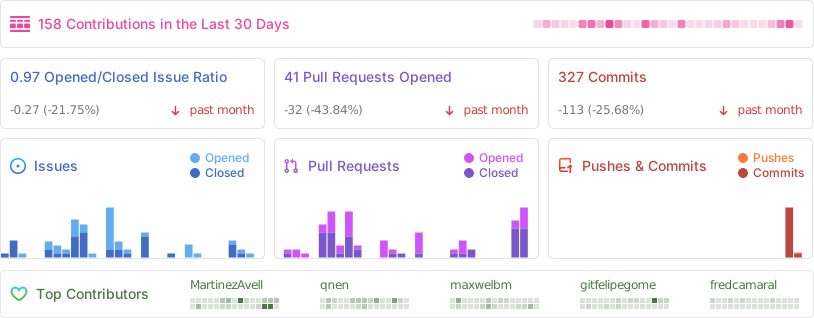
We welcome contributions from the community. Read our Contributing Guidelines to get started. Lerian Midaz is released under the Elastic License 2.0 (ELv2) — a source-available license that allows you to use, copy, modify, and redistribute Midaz, with three primary limitations: you may not provide it to others as a managed/hosted service, circumvent its license key functionality, or remove/obscure license notices.
Midaz is developed by Lerian, a tech company founded in 2024. Our team has a track record in developing ledger and core banking solutions. For inquiries or support, reach out at contact@lerian.studio or open a Discussion in our GitHub repository.