
A new programming language specifically made for scientists and engineers
Note: ~5 years ago at MIT
Note: to build complex compiled programs OR to have fast dynamic programs, you have 2 languages involved
- Brain-storm in a dynamic language for algorithm exploration and testing.
- Deliver a performant final-version in a compiled language.
Note: Most compiled programs had a testing stage in a dynamic language
Does a package/library do exactly
what you need?
             ├── Yes:   Great!
             ├── Dunno: You need to read C/++ code.
             └── No:    You need to code in C/++.
Note: R, Python, and MATLAB are coded mostly in C/++. Anything that is fast in those languages is coded in C/++.
- Benchmarks
- Solves the two-language problem
Juliais mostly coded inJulia!
Note: Julia is mostly coded in Julia!
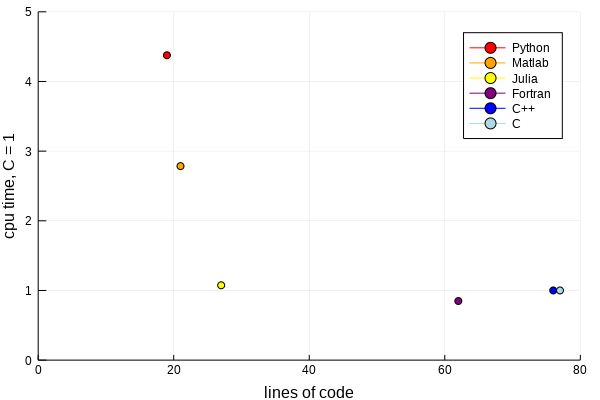
Note:
- I wrote a flexible and fast ray tracer in Julia. It's 100 LOC.
- The study "Mash: fast genome and metagenome distance estimation using MinHash" used MinHashing -- a fast algorithm for comparing two sets of things -- for DNA sequence comparison. They implemented it in C for speed. Someone else made python bindings to the compiled C version. But someone implemented it directly in Julia and made it super fast in under 100 lines of very readable code.
- Just-in-time compilation (JIT): User-level code is compiled to machine code on-the-fly.
- Meticulous type system: Designed to maximize impact of JIT.
- Multiple dispatch: Function dispatch determined at compile time when possible, run time when not.
Note: JIT compilation times are slow for first run
Looks like Python/MATLAB/R but with prettier syntax.
Note: Unicode characters, degree symbol, Greek letters, square root, units. Easy to read and understand, scientists are not programmers.
# rotate coordinate `c` by `θ` radians
julia> ↺(c, θ) = [cos(θ) -sin(θ); sin(θ) cos(θ)]*c
↺ (generic function with 1 method)

julia> [1,0] ↺ π/2
2-element Array{Float64,1}:
 0.0
 1.0
Note: This opens the door to tons of cool syntax.
It took a beetle 36 seconds to walk 25 cm. How many days will it take it to walk 3 km?
using Unitful:uconvert, cm, km, s, d
v = 25cm/36s
t = 3km/v
uconvert(d, t)
5 days
Note: if you use m, cm, feet, degrees, radians, etc
The concept of missing and NaN is treated correctly:
julia> NaN + 1         = NaN

julia> missing + 1     = missing

julia> true | NaN        ERROR!

julia> true | missing  = true

julia> false | missing = missing

julia> true & missing  = missing

julia> false & missing = false
Note: Consider that no other language has managed to get this concept of missing data correctly into their code.
Full access to all the libraries and functionalities you already know.
MATLAB.jl, RCall.jl, PyCall.jl, JavaCall.jl, Mathematica.jl, and ccall keyword to call C (and other languages, like Fortran and Rust)
Note: you can call Julia home without losing all of your furniture in the move.
- AxisArrays: Arrays where each dimension can have a named axis with ranged values.
- Images & Colors: Treat colors as a unit.
githubintegration: your code and its documentation accessible to everyone, automatically tested on multiple architectures, with coverage reports.
Note: Many many more, but it's outside the scope of this presentation, CI
- Easy to share and collaborate with anyone
- Drives the language forward
- Highly specialized and niche solutions and tools
- Free from hardware requirements
- No "black boxes", everything is within reach
Note: This is true for Python and R, but not MATLAB. Julia got git integration really well.
Mostly it's just too new…
Note: nothing is perfect.
- Ecosystems (e.g. packages, IDEs, debugger) not as mature as in other environments.
- Some of the more specialized libraries are missing.
- Harder to Google for answers.
Note: IDE (Integrated Development Environment). Maybe in 6 months or so the environment will solidify completely.
- Loading some packages is still a bit slow.
- Plotting works but hasn't settled yet.
- Transitioning into
v1.0.0: Major changes.
- Need statistics?
R - Need vectorized operations on matrices?
MATLAB Julia(likePython) is more general-purpose → can be harder to find what you're looking for.
Note: apropos statistics, Douglas Bates, the developer of the lme4 R package for GLMMs switched to Julia.
Juliais considered by many one of the best dynamic languages out there.- A number of libraries already far out-perform their equivalents in other languages.
- People come to
Juliabecause of its speed, but stay for the type-dispatch system ♥ - Suffers from being "too new": might not be suitable for early adopters.
Note: I've started using Julia about 4 years ago and never looked back.
