| title | Claude Code hook lifecycle and event system | ||||
|---|---|---|---|---|---|
| date | 2026-03-29 | ||||
| captured | 2026-03-29 08:03:16 UTC | ||||
| tags |
|
||||
| source | Claude.ai session: dwarves-kit design (March 29, 2026) | ||||
| aliases | |||||
| status | refined |
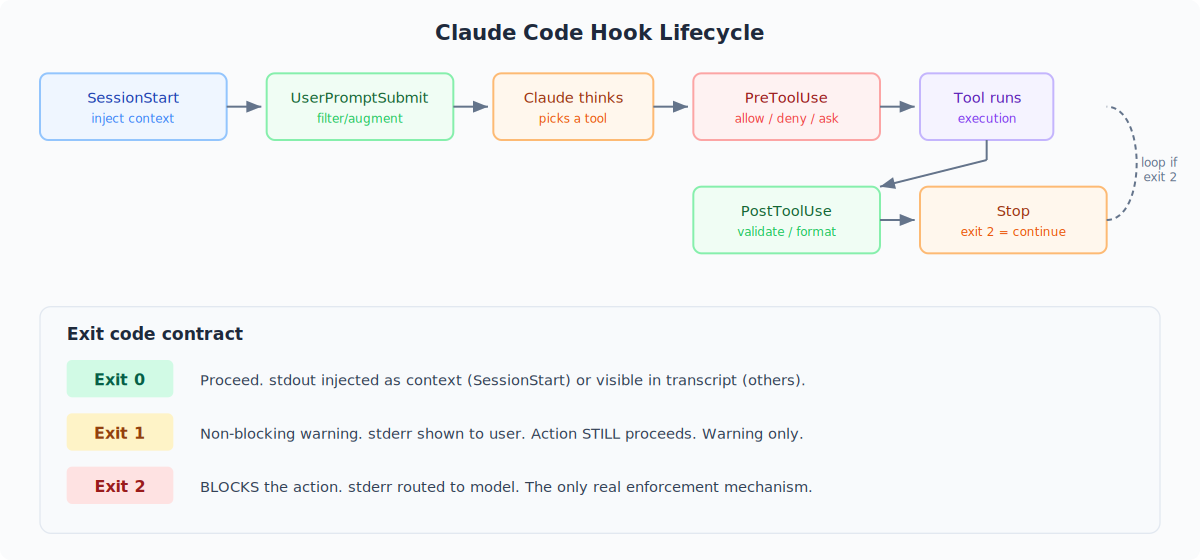
Claude Code exposes 21 lifecycle hook events that fire at specific points during a session. Hooks are the enforcement layer: unlike CLAUDE.md rules (followed ~70% of the time), a hook with exit code 2 is followed 100% of the time.
Think of hooks as interceptors at every decision point in the agent loop. The agent thinks, picks a tool, runs it, gets results, decides to stop or continue. Hooks can intercept before tool execution (gate it), after tool execution (validate it), and at the stop decision (force continuation).
Session boundaries -- setup, teardown, context management:
| Event | When | Key behavior |
|---|---|---|
| Setup | --init or --maintenance CLI flags |
One-time project initialization |
| SessionStart | Startup, resume, clear, compact | stdout becomes Claude's context (critical for injection) |
| SessionEnd | Exit, sigint, error | Cleanup, logging |
| PreCompact | Before conversation compaction | Last chance to save state before summarization |
User input -- before Claude processes a prompt:
| Event | When | Key behavior |
|---|---|---|
| UserPromptSubmit | User hits enter | Can inject context (stdout) or block the prompt |
Tool execution -- the core agent loop:
| Event | When | Key behavior |
|---|---|---|
| PreToolUse | After Claude picks a tool, before running it | Can allow, deny, or modify. The only hook that blocks tool execution. |
| PermissionRequest | When permission dialog would show | Can auto-approve or deny on behalf of user |
| PostToolUse | After tool succeeds | Validate output, run formatters, log results |
| PostToolUseFailure | After tool fails | Error logging, retry logic |
Agent control -- subagents and completion:
| Event | When | Key behavior |
|---|---|---|
| SubagentStart / SubagentStop | Subagent lifecycle | Hooks fire recursively for subagent tool calls too |
| Stop | Agent finishes response | Exit 2 forces continuation. Must guard against infinite loops via stop_hook_active. |
| Notification | Async alerts | Non-blocking. Good for desktop notifications. |
This is the single most important thing to understand:
| Exit code | Meaning | What happens |
|---|---|---|
| 0 | Success | Proceed. stdout visible in transcript. For SessionStart/UserPromptSubmit, stdout is injected as context. |
| 1 | Non-blocking error | stderr shown to user. Action STILL proceeds. Warning only. |
| 2 | Block | Action cancelled. stderr routed to the model. This is the only real enforcement. |
Every security hook MUST use exit 2, not exit 1. Exit 1 logs a warning. Exit 2 actually stops the action.
| Type | What it is | When to use | Latency |
|---|---|---|---|
| command | Shell script, reads JSON from stdin | Fast checks, pattern matching, file operations | <100ms |
| http | POST to an endpoint | Team-wide enforcement via shared server | Network-dependent |
| prompt | Single-turn LLM evaluation | Semantic judgment (is this rationalization?) | 2-5s, costs tokens |
| agent | Spawns subagent with tool access | Deep verification requiring codebase analysis | 10-30s |
Start with command hooks. Graduate to prompt hooks only when grep patterns aren't accurate enough.
Hooks run synchronously. Total hook execution time adds to every matched tool call. If a PostToolUse hook adds 500ms+ to every file edit, sessions feel sluggish. Profile with time before deploying. Ten fast hooks outperform two slow ones.
- [[claude-code-hook-schema-decision-values-per-event-type]] - the specific decision/permissionDecision values each event type accepts
- [[commands-vs-hooks-vs-skills-decision-framework]] - when to use hooks vs commands vs skills
- [[compaction-defense-patterns-for-claude-code-sessions]] - PreCompact and PostToolUse hooks applied to context management
- [[memory-systems-as-agent-harness-plugins]] - the same lifecycle hook pattern applied to memory systems in other agent harnesses