Given a root node reference of a BST and a key, delete the node with the given key in the BST. Return the root node reference (possibly updated) of the BST.
Basically, the deletion can be divided into two stages:
- Search for a node to remove.
- If the node is found, delete the node.
Example 1:
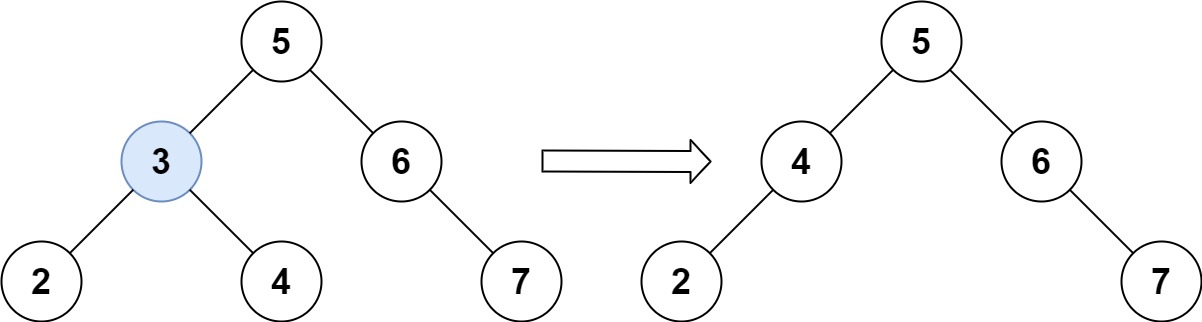
Input: root = [5,3,6,2,4,null,7], key = 3
Output: [5,4,6,2,null,null,7]
Explanation: Given key to delete is 3. So we find the node with value 3 and delete it.
One valid answer is [5,4,6,2,null,null,7], shown in the above BST.
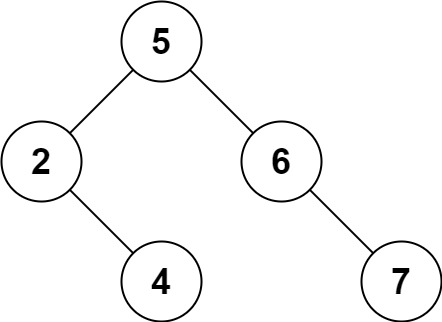
Please notice that another valid answer is [5,2,6,null,4,null,7] and it's also accepted.
Example 2:
Input: root = [5,3,6,2,4,null,7], key = 0
Output: [5,3,6,2,4,null,7]
Explanation: The tree does not contain a node with value = 0.
Example 3:
Input: root = [], key = 0
Output: []
Constraints:
- The number of nodes in the tree is in the range
[0, 104]. -105 <= Node.val <= 105- Each node has a unique value.
rootis a valid binary search tree.-105 <= key <= 105
Follow up: Could you solve it with time complexity O(height of tree)?
Companies:
Amazon, Microsoft, LinkedIn, Apple, Google, Oracle, Facebook
Related Topics:
Tree, Binary Search Tree, Binary Tree
Similar Questions:
// OJ: https://leetcode.com/problems/delete-node-in-a-bst/
// Author: github.com/lzl124631x
// Time: O(H)
// Space: O(H)
class Solution {
public:
    TreeNode* deleteNode(TreeNode* root, int key) {
        if (!root) return NULL;
        if (root->val > key) root->left = deleteNode(root->left, key);
        else if (root->val < key) root->right = deleteNode(root->right, key);
        else if (root->left) {
            auto p = root->left;
            while (p->right) p = p->right;
            root->val = p->val;
            root->left = deleteNode(root->left, root->val);
        } else if (root->right) {
            auto p = root->right;
            while (p->left) p = p->left;
            root->val = p->val;
            root->right = deleteNode(root->right, root->val);
        } else {
            delete root;
            root = NULL;
        }
        return root;
    }
};// OJ: https://leetcode.com/problems/delete-node-in-a-bst/
// Author: github.com/lzl124631x
// Time: O(H)
// Space: O(H)
class Solution {
public:
TreeNode* deleteNode(TreeNode* root, int key) {
if (!root) return NULL;
if (root->val > key) root->left = deleteNode(root->left, key);
else if (root->val < key) root->right = deleteNode(root->right, key);
else if (!root->left) {
auto right = root->right;
delete root;
return right;
} else if (!root->right) {
auto left = root->left;
delete root;
return left;
} else {
auto node = root->right;
while (node->left) node = node->left;
root->val = node->val;
root->right = deleteNode(root->right, root->val);
}
return root;
}
};// OJ: https://leetcode.com/problems/delete-node-in-a-bst/
// Author: github.com/lzl124631x
// Time: O(H)
// Space: O(H)
class Solution {
public:
TreeNode* deleteNode(TreeNode* root, int key) {
if (!root) return NULL;
if (root->val < key) {
root->right = deleteNode(root->right, key);
return root;
} else if (root->val > key) {
root->left = deleteNode(root->left, key);
return root;
}
if (!root->left || !root->right) return root->left ? root->left : root->right;
auto newRoot = root->right, left = newRoot->left, node = root->left; // Use `root->right` as the new root. Put `root->right->left` as the right child of the rightmost child of `root->left`.
newRoot->left = root->left;
while (node->right) node = node->right;
node->right = left;
return newRoot;
}
};