Given the root of a binary tree and an integer targetSum, return the number of paths where the sum of the values along the path equals targetSum.
The path does not need to start or end at the root or a leaf, but it must go downwards (i.e., traveling only from parent nodes to child nodes).
Example 1:
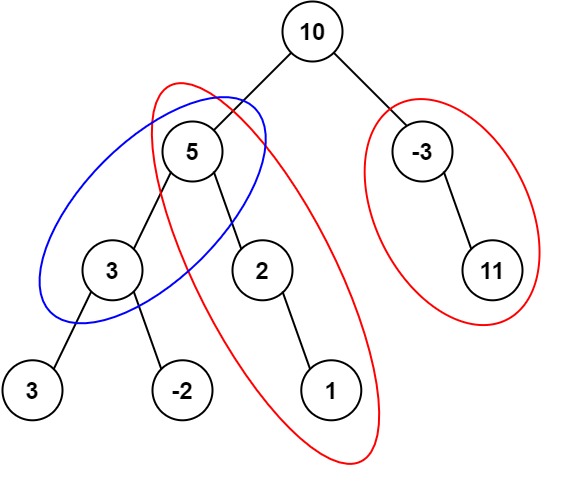
Input: root = [10,5,-3,3,2,null,11,3,-2,null,1], targetSum = 8
Output: 3
Explanation: The paths that sum to 8 are shown.
Example 2:
Input: root = [5,4,8,11,null,13,4,7,2,null,null,5,1], targetSum = 22
Output: 3
Constraints:
- The number of nodes in the tree is in the range
[0, 1000]. -109 <= Node.val <= 109-1000 <= targetSum <= 1000
Companies:
Facebook, Amazon, Microsoft, Bloomberg, Oracle, Adobe
Related Topics:
Tree, Depth-First Search, Binary Tree
Similar Questions:
// OJ: https://leetcode.com/problems/path-sum-iii/
// Author: github.com/lzl124631x
// Time: O(N^2)
// Space: O(N^2)
class Solution {
    int ans = 0;
    unordered_map<int, int> dfs(TreeNode *root, int sum) { // map of sums from the current node to a child node
        if (!root) return {};
        unordered_map<int, int> m{{root->val, 1}};
        auto left = dfs(root->left, sum), right = dfs(root->right, sum);
        for (auto &[val, cnt] : left) m[val + root->val] += cnt;
        for (auto &[val, cnt] : right) m[val + root->val] += cnt;
        if (m.count(sum)) ans += m[sum];
        return m;
    }
public:
    int pathSum(TreeNode* root, int sum) {
        dfs(root, sum);
        return ans;
    }
};// OJ: https://leetcode.com/problems/path-sum-iii/
// Author: github.com/lzl124631x
// Time: O(NlogN)
// Space: O(H)
class Solution {
private:
int cnt = 0;
void pathSum(TreeNode* root, int target, int sum) {
if (!root) return;
sum += root->val;
if (sum == target) cnt++;
pathSum(root->left, target, sum);
pathSum(root->right, target, sum);
}
public:
int pathSum(TreeNode* root, int sum) {
if (!root) return 0;
pathSum(root, sum, 0);
pathSum(root->left, sum);
pathSum(root->right, sum);
return cnt;
}
};Or
// OJ: https://leetcode.com/problems/path-sum-iii/
// Author: github.com/lzl124631x
// Time: O(NlogN)
// Space: O(H)
class Solution {
private:
    int pathSum(TreeNode* root, int target, int sum) { // count the paths starting from an acestor node to the current node whose sum equals `target`.
        return root ? ((sum += root->val) == target) + pathSum(root->left, target, sum) + pathSum(root->right, target, sum) : 0;
    }
public:
    int pathSum(TreeNode* root, int sum) {
        return root ? pathSum(root, sum, 0) + pathSum(root->left, sum) + pathSum(root->right, sum) : 0;
    }
}Note:
- Initially the map should have an entry
m[0] = 1so that we can count those paths starting from root. m[sum]++should go after accessingm[sum - targetSum], becausemstores the frequencies of path sums of the parent paths, excluding the current path. One corner case to consider istargetSum = 0. In this case,sum - targetSum == sum, so if we dom[sum]++before accessingm[sum - targetSum], we'll regard the path to the current node as a parent path, which is wrong.
// OJ: https://leetcode.com/problems/path-sum-iii/
// Author: github.com/lzl124631x
// Time: O(N)
// Space: O(N)
// Ref: https://leetcode.com/problems/path-sum-iii/discuss/91878/17-ms-O(n)-java-Prefix-sum-method
class Solution {
    unordered_map<long long, int> m{{0,1}}; // map from the path sum (from root to a parent node) to the corresponding count
public:
    int pathSum(TreeNode* root, int targetSum, long long sum = 0) {
        if (!root) return 0;
        sum += root->val;
        int ans = m.count(sum - targetSum) ? m[sum - targetSum] : 0;
        m[sum]++; // note that we should do this increment after accessing `m[sum - targetSum]`. Example case: root=[1], targetSum=0
        ans += pathSum(root->left, targetSum, sum) + pathSum(root->right, targetSum, sum);
        if (--m[sum] == 0) m.erase(sum);
        return ans;
    }
};