There is a 3 lane road of length n that consists of n + 1 points labeled from 0 to n. A frog starts at point 0 in the second lane and wants to jump to point n. However, there could be obstacles along the way.
You are given an array obstacles of length n + 1 where each obstacles[i] (ranging from 0 to 3) describes an obstacle on the lane obstacles[i] at point i. If obstacles[i] == 0, there are no obstacles at point i. There will be at most one obstacle in the 3 lanes at each point.
- For example, if
obstacles[2] == 1, then there is an obstacle on lane 1 at point 2.
The frog can only travel from point i to point i + 1 on the same lane if there is not an obstacle on the lane at point i + 1. To avoid obstacles, the frog can also perform a side jump to jump to another lane (even if they are not adjacent) at the same point if there is no obstacle on the new lane.
- For example, the frog can jump from lane 3 at point 3 to lane 1 at point 3.
Return the minimum number of side jumps the frog needs to reach any lane at point n starting from lane 2 at point 0.
Note: There will be no obstacles on points 0 and n.
Example 1:
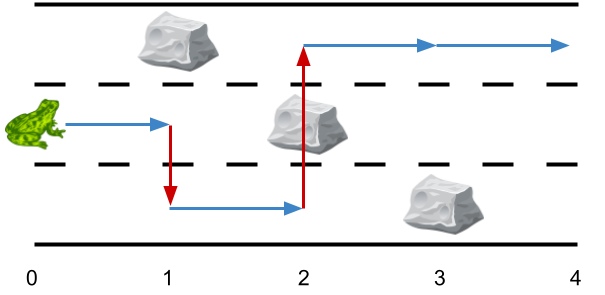
Input: obstacles = [0,1,2,3,0]
Output: 2
Explanation: The optimal solution is shown by the arrows above. There are 2 side jumps (red arrows).
Note that the frog can jump over obstacles only when making side jumps (as shown at point 2).
Example 2:
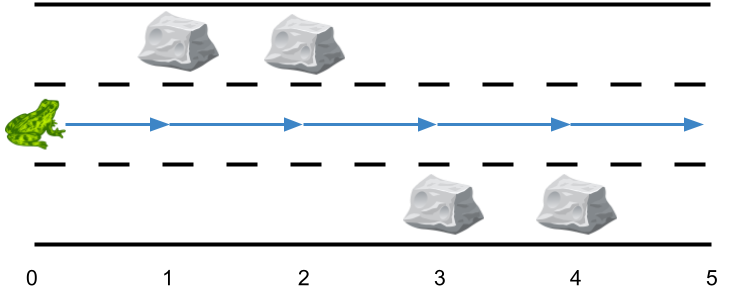
Input: obstacles = [0,1,1,3,3,0]
Output: 0
Explanation: There are no obstacles on lane 2. No side jumps are required.
Example 3:
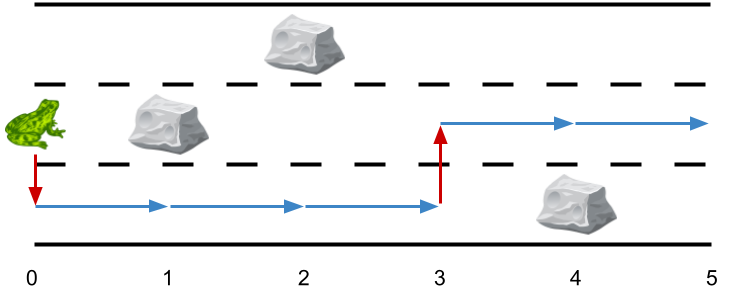
Input: obstacles = [0,2,1,0,3,0]
Output: 2
Explanation: The optimal solution is shown by the arrows above. There are 2 side jumps.
Constraints:
obstacles.length == n + 11 <= n <= 5 * 1050 <= obstacles[i] <= 3obstacles[0] == obstacles[n] == 0
Related Topics:
Dynamic Programming, Breadth-first Search
Similar Questions:
Let dp[i][j] be the minimum number of sideway jumps needed at index i and lane j. Let -1 mean unreachable.
Initial state:
dp[N - 1][j] =  0  if A[N - 1] != j + 1
                -1 if A[N - 1] == j + 1
State transition:
dp[i][j] =   -1                           if A[i] == j + 1
            dp[i+1][j]                    if A[i] != j + 1 && A[i + 1] != j + 1
           1 + min( dp[i][k] | k != j )   if A[i] != j + 1 && A[i + 1] == j + 1
// OJ: https://leetcode.com/problems/minimum-sideway-jumps/
// Author: github.com/lzl124631x
// Time: O(N)
// Space: O(N)
class Solution {
public:
    int minSideJumps(vector<int>& A) {
        int N = A.size();
        vector<vector<int>> dp(N, vector<int>(3, -1));
        for (int i = 0; i < 3; ++i) {
            dp[N - 1][i] = A[N - 1] == i + 1 ? -1 : 0;
        }
        for (int i = N - 2; i >= 0; --i) {
            int mn = INT_MAX;
            for (int j = 0; j < 3; ++j) {
                if (A[i] == j + 1 || A[i + 1] == j + 1) continue;
                mn = min(mn, dp[i][j] = dp[i + 1][j]);
            }
            if (A[i + 1] && A[i] != A[i + 1]) {
                dp[i][A[i + 1] - 1] = 1 + mn;
            }
        }
        return dp[0][1];
    }
};
We can also reduce the space complexity from O(3 * N) to O(3).
// OJ: https://leetcode.com/problems/minimum-sideway-jumps/
// Author: github.com/lzl124631x
// Time: O(N)
// Space: O(1)
class Solution {
public:
    int minSideJumps(vector<int>& A) {
        int N = A.size(), dp[3] = {-1, -1, -1};
        for (int i = 0; i < 3; ++i) {
            dp[i] = A[N - 1] == i + 1 ? -1 : 0;
        }
        for (int i = N - 2; i >= 0; --i) {
            int mn = INT_MAX, next[3] = {-1, -1, -1};
            for (int j = 0; j < 3; ++j) {
                if (A[i] == j + 1 || A[i + 1] == j + 1) continue;
                mn = min(mn, next[j] = dp[j]);
            }
            if (A[i + 1] && A[i] != A[i + 1]) {
                next[A[i + 1] - 1] = 1 + mn;
            }
            swap(next, dp);
        }
        return dp[1];
    }
};