There are n servers numbered from 0 to n - 1 connected by undirected server-to-server connections forming a network where connections[i] = [ai, bi] represents a connection between servers ai and bi. Any server can reach other servers directly or indirectly through the network.
A critical connection is a connection that, if removed, will make some servers unable to reach some other server.
Return all critical connections in the network in any order.
Example 1:
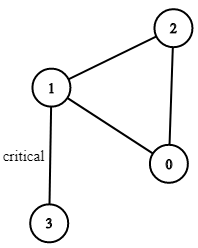
Input: n = 4, connections = [[0,1],[1,2],[2,0],[1,3]]
Output: [[1,3]]
Explanation: [[3,1]] is also accepted.
Example 2:
Input: n = 2, connections = [[0,1]]
Output: [[0,1]]
Constraints:
2 <= n <= 105n - 1 <= connections.length <= 1050 <= ai, bi <= n - 1ai != bi- There are no repeated connections.
Related Topics:
Depth-First Search, Graph, Biconnected Component
An edge is a critical connection, if and only if it is not in a cycle.
So we need to find the cycles and discard all edges in them. The remaining connections are those critical.
Here we use DFS + ranks. ranks[u] is the depth of a node during DFS. The starting node has a rank 0.
ranks are initialized as -INF meaning that the nodes are unvisited. A valid rank value is in [0, n).
When we do DFS on node u and we see a neighbor v that has ranks[v] != -INF and rank[v] < rank[u] - 1, we know that v is an ancestor node of u and uv is on a cicle.
But only the current level of search knows it finds a cycle. To let upper levels of search know, we make use of the return value of DFS: dfs function returns the minimum rank it finds. During a step of search from node u to its neighbor v, if dfs(v) returns something smaller than or equal to ranks[u], then u knows its neighbor v helped it to find a cycle back to u or u's ancestor. So u knows it should discard the edge uv which is in a cycle.
// OJ: https://leetcode.com/problems/critical-connections-in-a-network/
// Author: github.com/lzl124631x
// Time: O(V+E), since this is a connected graph, E >= V-1, so here `O(V+E) == O(E)`.
// Space: O(E)
// Ref: https://leetcode.com/problems/critical-connections-in-a-network/discuss/382638/DFS-detailed-explanation-O(orEor)-solution
class Solution {
public:
    vector<vector<int>> criticalConnections(int n, vector<vector<int>>& E) {
        vector<int> ranks(n, INT_MIN); // INT_MIN unvisited, 0~n-1 rank values
        vector<vector<int>> G(n), ans;
        for (auto &e : E) {
            int u = e[0], v = e[1];
            G[u].push_back(v);
            G[v].push_back(u);
        }
        function<int(int, int)> dfs = [&](int u, int rank) {
            if (ranks[u] >= 0) return ranks[u];
            ranks[u] = rank;
            int minRank = rank;
            for (int v : G[u]) {
                // The relationship between `ranks[v]` and `rank` only has the following cases:
                // 1. ranks[v] == rank - 1: `v` is visited and is the direct parent node of `u` in the DFS path.
                // 2. ranks[v] > rank: `v` has been visited and is a child of `u`. There exists a circle containing edge `uv`. Since `v` is already visited, we don't want to visit it again
                // 3. ranks[v] < rank - 1: There are two subcases
                //    3.1. ranks[v] == -INF. `v` is not visited.
                //    3.2. ranks[v] != -INF && ranks[v] < rank - 1: `v` is an ancestor node of `u`, so `uv` is on a circle.
                // Note that `ranks[v] == rank` is impossible.
                if (ranks[v] >= rank - 1) continue;
                int neighborMinRank = dfs(v, rank + 1);
                minRank = min(minRank, neighborMinRank);
                if (neighborMinRank > rank) ans.push_back({u, v}); // if neightborRank > rank, this edge `uv` is not on any circle -- it's a critical path
            }
            return minRank;
        };
        dfs(0, 0);
        return ans;
    }
};