Hey there! I'm Python Cat. Every week I curate the best Python, AI, and tech content for you. This newsletter is open source on Github, so drop us a star if you dig it! ⭐
This week we're featuring 12 articles and 12 open source projects.
1、Create a React + Flask Project in 2025
A solid React + Flask tutorial that shows how to ditch the deprecated create-react-app for Vite when building React frontends. The author walks through modern project structure, virtual environment setup, and hot module reloading - basically everything you need for full-stack development best practices.
2、How I'm bundling frontend assets using Django and rspack these days
What's the modern frontend bundling solution for Django projects? This dev shares their complete migration from Webpack to rspack, implementing hot module reloading, content hash caching, and production optimizations through configuration libraries and template tags. Solves all those common frontend asset bundling and deployment headaches.
3、Python: sharing common tests in unittest
Sharing common tests means centralizing test logic that's shared across multiple objects or classes into a base class or module. This article breaks down three implementation approaches: base class deletion, test class mixins, and pytest's __test__ attribute, analyzing the pros and cons of each.
4、Local Speed, Smooth Deploys: Heroku Adds Support for uv
Heroku just announced support for uv, the Rust-powered Python package manager that's way faster than traditional pip for dependency resolution and installation. The post reviews Python package management evolution and dives into uv's core advantages: lightning-fast installs, efficient dependency resolution, and compatibility with existing standards.
5、Ways to Optimize Your Code in Python
Four solid Python performance optimization techniques: choosing better data structures (tuples are 6x faster than lists, dicts and sets have O(1) lookup), scope management (local variables are 50% faster than globals), list comprehensions and generator expressions, plus making the most of built-in functions and libraries.
PEP 794 proposes adding an Import-Name field to Python package metadata to record the import names provided after project installation. This fixes the mismatch between project names and import names, helping IDEs accurately recommend packages and assisting with junk package detection.
7、How to split up a Django monolith without using microservices
The author built django-queuebie to tackle Django monolith complexity through synchronous message queues implementing command and event patterns. It breaks down complex business logic into tiny independent message processors, supporting cross-boundary decoupling while avoiding microservices overhead.
8、How local variables work in Python bytecode
The author built Memphis, a Rust-based Python interpreter, and dives deep into how local variables work in bytecode - covering stack storage mechanisms for local variables and the bytecode compilation and execution process.
9、Globally Disabling Foreign Keys in Django
This article explains foreign key benefits and why big company DBAs usually disable them (maintenance difficulties, performance impact, sharding limitations). It provides an efficient solution: inheriting Django's MySQL engine and setting supports_foreign_keys = False to globally disable foreign key generation.
10、I made a worse search engine than Elasticsearch
The author shares their experience building SearchArray to add full-text search to Pandas, discovering through BEIR benchmarks that it performed worse than Elasticsearch across the board. The post analyzes search engine optimization techniques, including how the WAND algorithm avoids unnecessary computations, differences between positional and traditional inverted indexes, and why real search engines achieve high performance.
11、Chat with your PDF using Pinata,OpenAI and Streamlit
How do you build an app that lets users upload PDFs and chat with the content? This tutorial uses Pinata for decentralized file storage, OpenAI API for natural language processing, and Streamlit for the UI to create a simple PDF chat application.
The author calls themselves a Python "dinosaur" for using Python since version 1.5 but only recently discovering Poetry for project dependency management. Covers setting up Poetry in existing projects, including installation via pipx, shell environment configuration and completion, plus the complete process of migrating requirements.txt projects to Poetry.
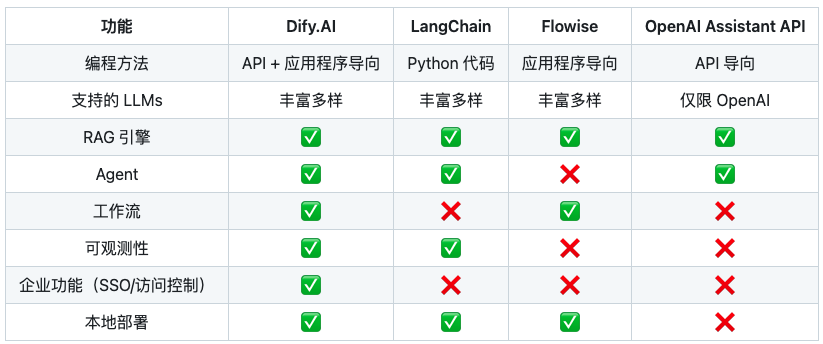
1、dify: Dify is an open-source LLM app development platform
Dify just hit 100K stars! 🎉 This open-source project from a Chinese team integrates AI workflows, RAG pipelines, agents, model management, and observability through an intuitive interface, letting you go from prototype to production deployment fast. (101K stars)
2、sequor: Sequor is a SQL-centric platform for building API integrations
A SQL-centric workflow platform for building reliable API integrations in modern data stacks. Supports YAML workflow definitions, Jinja or Python dynamic parameters, and SQL logic processing.
3、bilive: Extremely fast live recording, automatic slicing, rendering, uploading and Integrating MLLMs
Blazingly fast Bilibili live stream recording with automatic slicing, bullet comment rendering, subtitle generation, and auto-upload to Bilibili. Integrates multiple modal models and works on ultra-low-spec machines. (2.5K stars)
A Docker Compose template that bundles Ollama local LLMs, Open WebUI chat interface, n8n workflow platform, Supabase database, Flowise AI agent builder, Neo4j knowledge graph engine, and more components into a one-stop solution for self-hosted AI workflows. (1.8K stars)
Microsoft's open-source natural language web interaction platform that simplifies building conversational interfaces for websites. Native MCP protocol support and leverages structured formats like Schema.org for rapid conversational endpoint implementation. (4.9K stars)
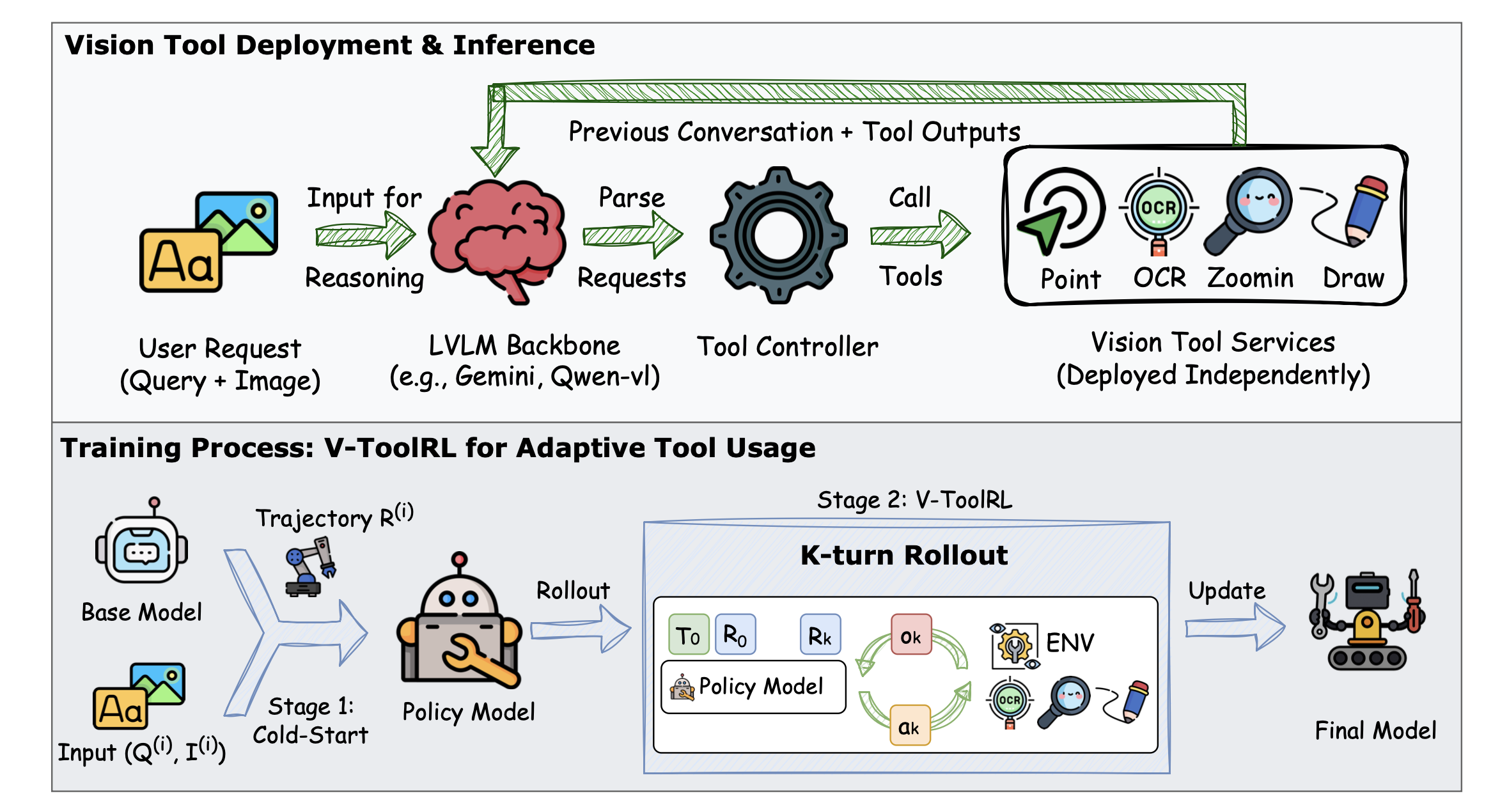
Through flexible visual tool management, distributed tool deployment, and innovative V-ToolRL reinforcement learning, this framework enables AI agents to interactively use visual tools to decompose, analyze, and solve complex visual problems.
7、pageql: Embed SQL directly into HTML
A template language and micro Python web framework that lets you embed SQL statements directly in HTML. Inspired by ColdFusion and HTMX, it supports reactive rendering with automatic updates when database data changes.
8、AutoAgent: Fully-Automated and Zero-Code LLM Agent Framework
A fully automated, highly autonomous development framework that creates and deploys LLM agents using just natural language. Shows excellent performance on GAIA benchmarks, rivaling OpenAI's Deep Research. (4.6K stars)
Stores reusable text KV caches across GPU, CPU memory, local disk, and other locations to enable cache reuse for reduced latency and improved throughput. (1.3K stars)
10、davia: The easiest way to build apps from your Python code
A framework for quickly converting programs (especially AI agents and data-driven internal tools) into interactive web apps. Built on FastAPI with real-time streaming updates and automatic UI generation.
11、ovld: Advanced multiple dispatch for Python functions
A fast Python multiple dispatch library supporting type annotation-based function overloading. Unlike singledispatch, it supports dispatching on multiple parameters. Provides advanced features like variants, mixins, value-based dispatch, and keyword argument dispatch.
12、arc-export: Export pinned Arc Browser tabs for importing bookmarks into other browsers
A Python script that converts Arc browser's pinned tabs into standard HTML bookmark files, solving Arc's lack of pinned tab export functionality. (Nearly 1K stars - didn't realize the demand was this huge!)
Python Trending Weekly #55: Sharing 9 High-Quality Tech Information Sources! (2024.06.10)
Python Trending Weekly #5: How Much Memory Does It Take to Run a Million Concurrent Tasks? (2023.06.03)
Tech newsletters are how smart people filter quality knowledge in our information-overloaded world. This platform is crafted specifically for Python developers, curating the most valuable articles, tutorials, open source projects, tools, podcasts, videos, and trending topics. Subscribe now to get weekly updates and level up bit by bit.
Drop a comment and tell us which share you liked most this week! The more feedback we get, the more content we'll share!