| title | <Python><PAT> 1066 Root of AVL Tree | ||
|---|---|---|---|
| date | 2019-08-29 08:21:31 -0700 | ||
| tags |
|
||
| cover | http://pwb80dtf4.bkt.clouddn.com/PAT-cover.webp | ||
| categories | PAT | ||
| top_img | http://pwb80dtf4.bkt.clouddn.com/PAT-top.webp | ||
| description | 应该是超纲题。 |
An AVL tree is a self-balancing binary search tree. In an AVL tree, the heights of the two child subtrees of any node differ by at most one; if at any time they differ by more than one, rebalancing is done to restore this property. Figures 1-4 illustrate the rotation rules.
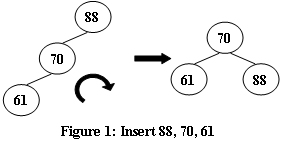
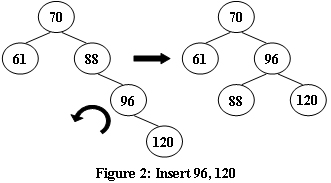
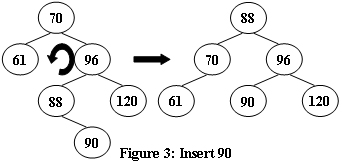
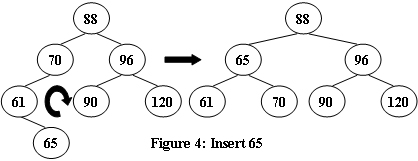


Now given a sequence of insertions, you are supposed to tell the root of the resulting AVL tree.
Each input file contains one test case. For each case, the first line contains a positive integer N (≤20) which is the total number of keys to be inserted. Then N distinct integer keys are given in the next line. All the numbers in a line are separated by a space.
For each test case, print the root of the resulting AVL tree in one line.
5
88 70 61 96 120
70
7
88 70 61 96 120 90 65
88
- 考纲里没有AVL树的内容,所以应该是不考的。
- 写法就是按照题目意思,构造一个AVL BST。
- Node 是一个节点,属性包含
- val
- left
- right
- rotateLeft 是左旋
- 就是当右边太长的时候
- 把右节点当成根节点
- 方法是,根的右节点改为右节点的左节点,而右节点的左节点改为根。
- 返回这个新的根节点
- rotateRight 是右旋
- 就是当左边太长的时候
- 把左节点当成根节点
- 方法是,原根的左节点改为左节点的右节点,而左节点的右节点改为原根。
- 返回这个新的根节点
- 以上两步画图就好理解了。
- getHeight 找到这个节点的高度,这个没什么问题
- insert 插入一个数,并返回根节点。
- 插入的时候,从根节点不断比大小找到应该放的位置
- 放完了后,判断有没有造成不平衡
- 即左子树和右子树的差的绝对值有没有大于2
- 不平衡了那么就需要rotate
- 但是要注意一件事情
- 举例来说,如果我往左侧插入一个数,造成了不平衡,左边太长了,这时候想到要右旋
- 如果要插入的数比根结点的左侧还要大,即,它应该才是根的左节点
- 这种情况下,要先对左子树进行左旋。
- 为什么要这样做呢?因为每次右旋都会使根变成根的左节点,而这时候根的左节点并不是新节点,所以右旋是错误的。
- 我们这样处理,就相当于把原来的根节点的左节点压下去了。
- 反正是超纲的,问题不大,不会不用管就行。
- 因为使用Python3能AC,所以只放了Python的代码。
class Node:
    def __init__(self, val):
        self.val = val
        self.left = None
        self.right = None

    def rotateLeft(self):
        node = self.right
        self.right = node.left
        node.left = self
        return node

    def rotateRight(self):
        node = self.left
        self.left = node.right
        node.right = self
        return node

    def getHeight(self):
        left = 0 if not self.left else self.left.getHeight()
        right = 0 if not self.right else self.right.getHeight()
        return max(left, right) + 1

    def insert(self, val):
        if not self.val:
            self.val = val
            return self

        if self.val > val:
            self.left = Node(val) if not self.left else self.left.insert(val)
            left = 0 if not self.left else self.left.getHeight()
            right = 0 if not self.right else self.right.getHeight()
            if (left - right) == 2:
                if val >= self.left.val:
                    self.left = self.left.rotateLeft()
                self = self.rotateRight()
        else:
            self.right = Node(val) if not self.right else self.right.insert(val)
            left = 0 if not self.left else self.left.getHeight()
            right = 0 if not self.right else self.right.getHeight()
            if (left - right) == -2:
                if val <= self.right.val:
                    self.right = self.right.rotateRight()
                self = self.rotateLeft()
        return self


root = Node(None)
_ = input()
for i in input().split():
    root = root.insert(int(i))
print(root.val)